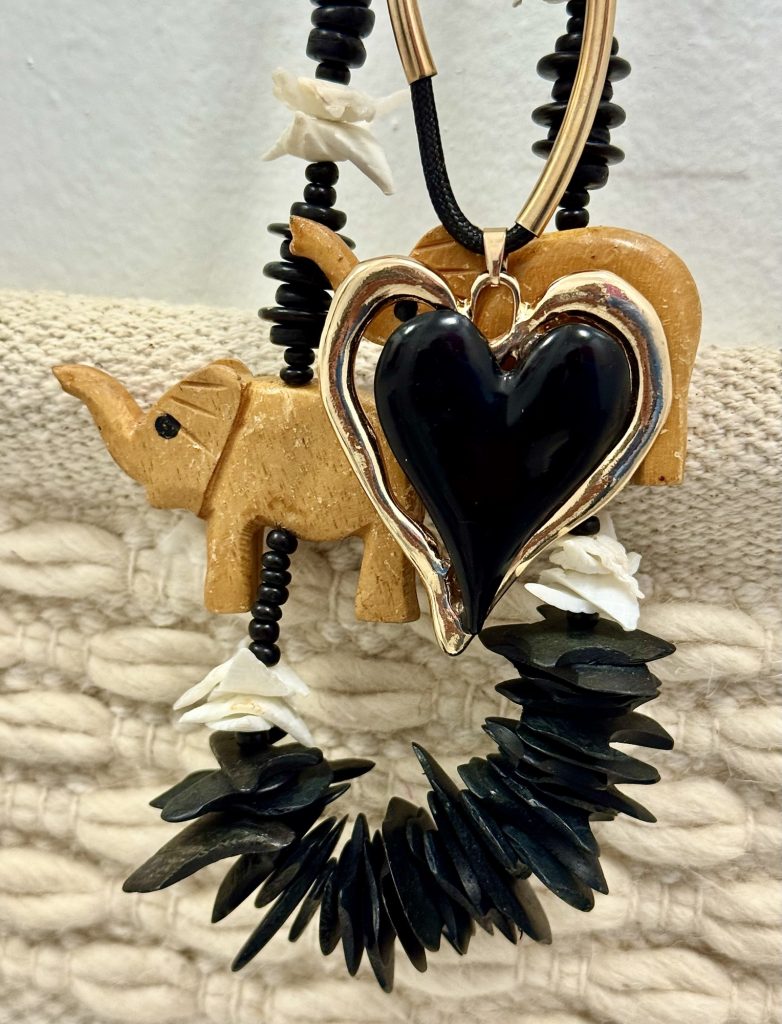
Brooklyn Smith does not simply design jewelry; she composes constellations meant to be worn.
In her studio, light behaves like a collaborator. Morning arrives softly, filtered through gauze curtains, touching sheets of metal, slivers of carved wood, rods of glass, and a velvet tray where diamonds wait with patient, ancient indifference. On the central worktable lies a half-finished piece: a brooch unfurling like a flower not yet cataloged by botany, its geometry echoing Adinkra ideographs—symbols of memory, endurance, interdependence.
Smith moves with the assurance of someone who understands that ornament, at its highest register, is philosophy. Her work is Afrocentric yet unbounded, rooted yet planetary. Petals appear in brass and oxidized silver, spirals emerge from ebony and translucent glass, chromatic planes collide—cobalt against gold, crimson against smoke. Nothing is decorative for decoration’s sake. Every line is a proposition.
This season, her practice bends toward a new axis: futurism braided with ancestry. “I’m looking for the African,” she says, “and the citizen of the world.” In Smith’s lexicon, the two are not opposites but mirrors.
Pinned above her drafting desk is a handwritten note: HEXAGRAM 8 — Pi: Unity, Co-ordination. It is not there as mysticism, but as method.
Water above earth.
The ancient text speaks of assembly, of hearts drawn together, of the peril of lagging behind the current of collective movement. Smith reads it as both omen and instruction. Jewelry, after all, is an intimate architecture of relation: between maker and wearer, body and object, past and possibility.
In anticipation of the Chinese New Year, Smith begins a series she calls Flowing Bowl. The pieces shimmer with kinetic balance—necklaces that seem poured rather than constructed, earrings that hold tension like suspended droplets. Circular forms repeat with subtle variations, invoking continuity rather than closure. She incorporates red lacquered wood beside cool steel, jade-toned glass beside diamond pavé. The palette nods to celebration; the structures whisper of convergence.
The first line of the hexagram becomes a quiet manifesto in metal: Where there is confidence, unification proceeds flawlessly. There is a windfall yet to come.
Confidence, here, is not bravado but fluency. Smith trusts materials that resist her. She coaxes glass into obedience, persuades wood to honor angles, convinces metal to curve like breath. In her hands, disparate mediums negotiate rather than compete.
The second line—unification from within one’s own circle—finds expression in collaboration. Smith invites a woodworker versed in West African carving traditions, a glass artist trained in kiln-formed translucency, a metalsmith obsessed with micro-hinges invisible to the eye. The studio becomes an ecosystem. Ideas circulate. Authority dissolves into dialogue.
Unity is not sameness; it is orchestration.
But the hexagram warns, too. The third line cautions against alliances with what corrodes. Smith recalls early offers that promised visibility at the expense of integrity: shortcuts in craftsmanship, dilution of symbolism, spectacle over substance. She declined. Disaster sometimes wears the mask of opportunity.
By the fourth line, the text gestures outward—co-operation beyond the immediate circle. Smith’s work travels: exhibitions in cities where viewers trace unfamiliar symbols with reverent curiosity, collectors who speak different languages yet recognize the grammar of care embedded in her designs. Her jewelry becomes a site of meeting.
The fifth line tells of a king who loses the quarry ahead because the people were not warned. Smith reads this as a meditation on communication. Art, however refined, falters if it withholds its invitation. She begins writing more—about Adinkra meanings, about material choices, about the ethics of adornment. Context, she understands, is not explanation but hospitality.
And the top line, stark as winter:
Attempts at unity without leadership result in disaster. Leadership, in Smith’s world, is not hierarchy but coherence. The artist must hold the center—not to dominate, but to align. Without that gravitational force, even brilliance scatters.
On New Year’s night, beneath lanterns and the percussive joy of celebration, Smith wears one of her own creations: a pendant where a diamond rests at the nexus of intersecting planes, metal and wood meeting like continents. It catches light, then releases it, as if demonstrating the simplest and most elusive truth:
Beauty is what happens when elements agree to belong to one another.
In Brooklyn Smith’s hands, unity is neither slogan nor symbol alone. It is structure, discipline, destiny—water lying upon the land, co-ordination made visible, a future assembled from fragments that were never truly separate.