GS3 Worldwide
The GS3 Team is a multi-media design firm that individually designs personal sessions and packages for weddings, corporate, fashion and family photography, and other multi-media art for private and corporate collections. Company Overview GS3 Street Team is a next-generation web-based advertising firm that serves the emerging music entertainment/night club market for events promotion and direct marketing. Located worldwide, we have ready access to the sharpest interns and recent graduates from several universities. Our advertising and promotional campaigns appeal to the local night club/concert market segment. By offering several quality options, we meet the primary needs of three market segments, with additional options for customers transitioning between market segments. In 2007, founder Georgio Sabino III and Team has recognized the opportunity to provide efficient and cost-effective advertisement and promotional marketing services to the local night club/concert industry with few online sources available to meet the needs of the local entertainment industry. Recent changes in the geographic and economic environment have increased the demand for advertisement and promotional marketing services which make it extremely appealing for our prospective clients to reach out through e-commerce and web-based marketing. The GS3 Team sees this as a prime opportunity to apply his business interests and experience to yield high potential profits and work in the area of his greatest passion.
Description GS3 art, fashion, and photography team has worked with celebrities, professional athletes, and prominent members of the political, religious and entertainment communities and the community at-large.
Mission We, the GS3 team engages as a partner-focused, collaborative approach for those who employ the firm's services, working with a team of beauty, fashion and corporate image experts, to create results that are custom tailored for each individual, family or company. It’s our pleasure to photograph your event weather it’s a weddings, birthdays, anniversaries, showers, gala gatherings, and corporate events we will capture your special moments in the atmosphere as exciting as your occasion and highlight the all the characteristics. -- The GS3 Team
How can I add value? *
Your professional and personal image will be heightened by the eye and skills of the GS3 team.
#GS3Photography,
@GS3Photography, #GS3Photography, GS3 Photography, Georgio Sabino III, Wedding Photographer, Wedding Photography, Hire Photographer, Event Photographer, Quality Photographer, Best Photographer Ever!, Affordable, Engagements, Bride & Groom, Family Sessions,
www.GS3.us
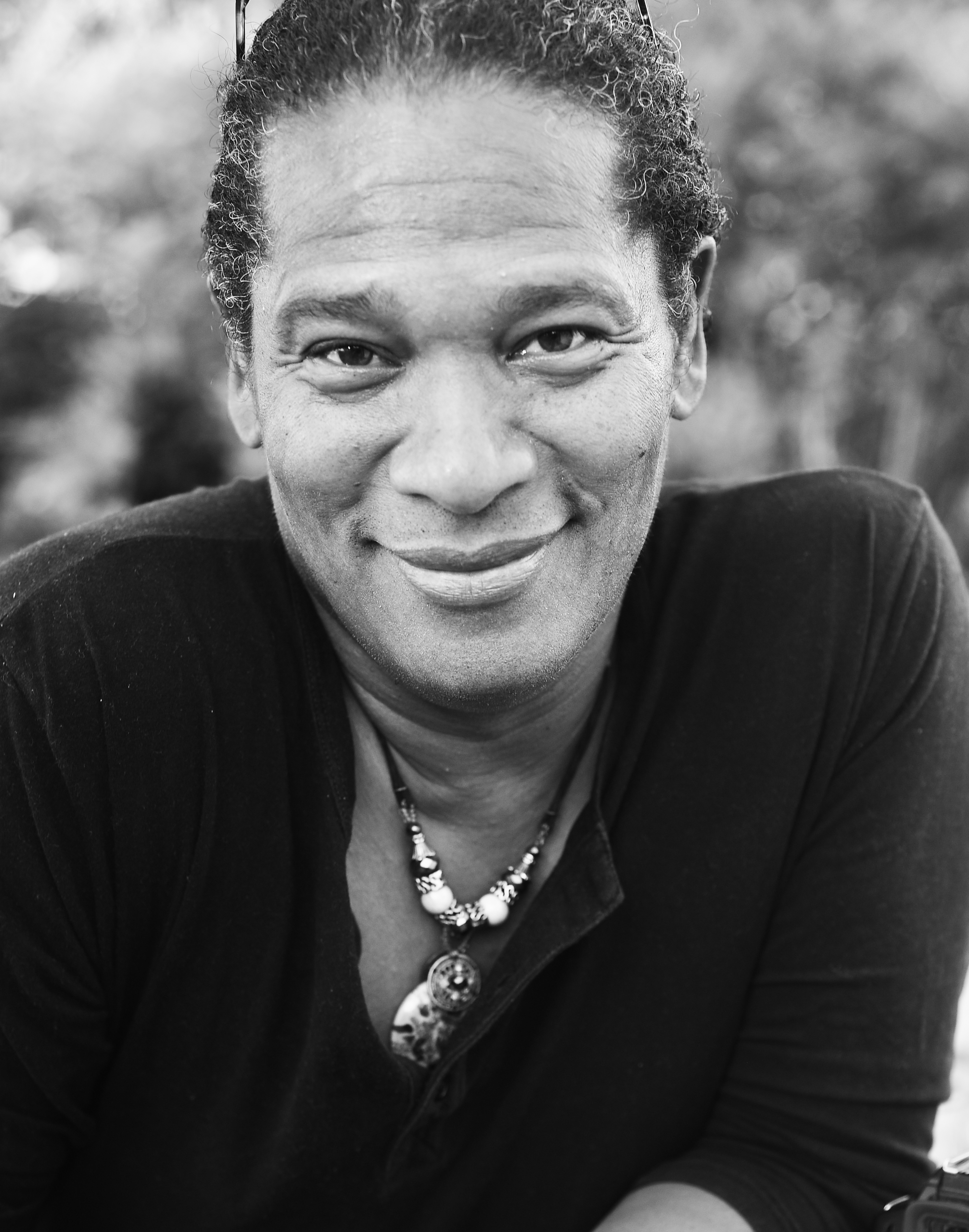
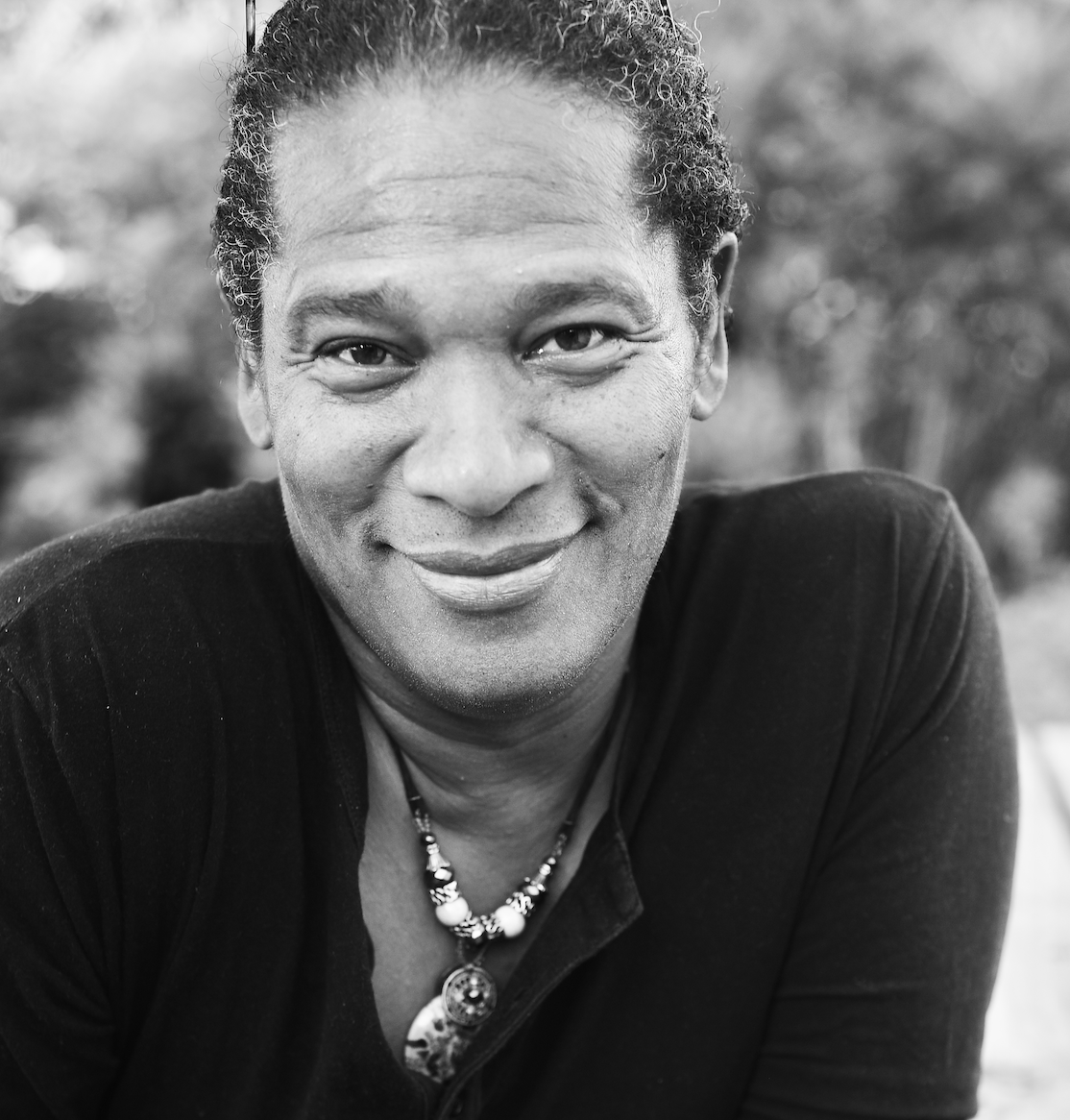
GS3 is a prominent multi-disciplinary Cleveland-based artist, educator, photographer, and tech innovator known for his vibrant, contrasting digital art, fashion design, and mentorship in art education, having served as a White House photographer for national champions and co-founding initiatives like GoVia for community safety, blending creativity with technology to empower people and solve problems.
Key Aspects of His Work & Career:
Artistic Style: His digital art features dramatic lines, vibrant colors, and strong contrast, often inspired by his original paintings and incorporating unconventional textiles and bold fashion.
Photography: He gained prominence photographing championship wins for the Ohio State Buckeyes and Cleveland Cavaliers at the White House under President Obama.
Education & Mentorship: An “artist teacher,” Sabino teaches at institutions like Ursuline College and Tri-C, focusing on artistic growth and business skills, and mentors youth through programs funded by the Gund Foundation.
Business & Innovation: He’s the owner of GS3 Innovations, LLC, and developed GoVia, a platform blending art and tech to create community-focused digital solutions.
Community Focus: He uses his platform to build connections, raise visibility for organizations, and promote unity, as seen in projects like “The Next 400”, which focused on racial understanding.
In essence, Georgio Sabino III is a visionary combining fine art with technology, business acumen, and a deep commitment to education and community building in Northeast Ohio and beyond, leaving a significant mark through his visually striking work and mentorship.
This paper explores a new conceptual art form: the Afro-Creole titanium coin, an object that evokes layered histories — West African diasporic aesthetics, Classical Creole idealism, and Pharaonic Egyptian symbology — as an artistic artifact embodying ancestral recurrence and speculative futurity. Anchoring this vision is the multidimensional artist Georgio Sabino III (GS3), whose interdisciplinary practice connects ancient cosmologies to Afro-punk sensibilities, reaffirming lineage while charting new cultural imaginaries.
1. Introduction: Reimagining Coinage as Living Archive
Coins have historically functioned as mobile archives — carrying the visage of rulers, the stabilizing imagery of states, and symbolic messages that encode power. Classical Afro-Creole coinage, for example, was a medium of philosophy, politics, divine myth, and civic pride. When combined with Egyptian hieroglyphic inscriptions, the coin becomes a palimpsest of cultural chronologies. In GS3’s conceptual design, titanium — a material associated with industrial futurism and endurance — replaces ancient silver, binding durability with cultural resonance.
This coin is more than an object: it is a syncretic artifact that speaks to diasporic memory, ancestral reverence, resistance aesthetics, and the Afro-punk ethos — an artistic movement that embraces Afrocentric futurity fused with countercultural expression.
2. Afro-Creole Identity with Greek Influences: Historical Resonances and Diasporic Aesthetics
The notion of Afro-Creole identity has emerged not from geographic co-location but through cultural translation across histories. During antiquity, Egypt (Kemet) stood at the crossroads of Mediterranean, African, and Near Eastern worlds. Greek travelers, scholars, and later conquerors encountered Egyptian cosmologies, triggering mutual influence in art, religion, and philosophy.
For the African American diasporic subject, connecting to these trans-Mediterranean architectures of thought means reclaiming intellectual genealogies often elided in Western curricula — from the contributions of Egyptian mathematics and cosmology to the presence of scholars of African descent in Hellenistic schools.
GS3’s coin design visualizes this linkage: the embossed profile, inspired by a living contemporary’s visage (though not a literal portrait), carries the weight of ancestral specificity — a phenomenology of Black subjectivity that resists flattening.
3. Blue Curled Strand: Symbolism of Ancestral and Future Currents
The striking blue curled hair strand — modern, surreal, and metaphoric — functions as an embodied signifier. Blue, across cultures, symbolizes both the infinite (sky, water) and the sacred. In this instance:
Curls represent African hair textures historically stigmatized yet central to identity affirmation.
Blue pigment evokes ancient Egyptian faience and lapis lazuli, materials associated with royalty and the divine.
The coexistence of hair and metallic relief on the coin bridges era and expression, signifying continuity between ancestral material cultures and contemporary aesthetics.
Thus, this visual element is not decorative but a philosophical signpost to temporal continuity, a motif of lineage that flows but never breaks.
4. Egyptian Hieroglyphs, Afro-Creole & Greek Letterforms, and Polyvocal Inscription
Around the rim of these coins, an interplay of Afro-Creole – Greek letterforms and Egyptian hieroglyphic motifs signals a polyvocal inscription. Unlike classical coins that often employ standardized imperial text, this hybrid script is a poetic encoding of:
Names and sounds that reflect diasporic phonologies
Concepts such as “heritage,” “resistance,” “memory,” and “becoming”
Mnemonic devices that demand the viewer participate in decoding the narrative
In anthropological terms, this script acts as an agogic threshold, inviting interpretation through multiple cultural grammars while affirming an inclusive archive.
5. Three Pyramids as Temporal Locus
In the variante coin with three pyramids, we find an architectural horizon that is both rooted and speculative. The pyramids symbolize:
Domesticated ancestral past (Old Kingdom Egypt)
Mnemonic stasis — a testament to enduring creativity
Three temporal registers: past, present, and future
The pyramids here do not merely recall antiquity; they function as transhistorical portals, aligning the Afro-Creole and Afro-punk imaginary with cosmic continuity. GS3’s use of this imagery situates his work within a lineage of Black futurist speculation — where heritage is not static but evolves as resonant frequencies — echoing Octavia Butler’s insistence that “all that you touch you change, all that you change changes you.”
6. The Afro-Punk Inflection: Heritage as Futuristic Practice
Afro-punk, as a cultural movement, is liberatory and transgressive, channeling self-authorship through fashion, music, performance, and visual art. GS3’s lineage from this aesthetic is evident:
Through fusion of classical and contemporary signifiers
Through gender-affective visual language
Through disturbance of normative historical narratives
Through cinematic and expressive imagery grounded in diasporic embodiment
The potential of the coin as wearable art, collectible sculpture, and cultural manifesto positions it as emblematic of a broader Afro-punk future that reframes ancestry not as static reverence but dynamic resistance and reinvention.
7. GS3 Conclusion: Objects That Speak Across Time
In summation, the conceptual Afro-Creole titanium coins are not only artistic artifacts; they are vectors of memory, identity, and futurity — interweaving African American ancestral threads with Mediterranean and Egyptian forms. These objects function as philosophical provocations, inviting viewers and collectors to reconsider how material art carries lineage, transforms narratives, and inspires renewed imagination. “This came from a dream to reality” – GS3 says.
At the heart of this is Georgio Sabino III, whose multifaceted practice — spanning photo-media, conceptual sculpture, writing, and community engagement — embodies a creative ethos that knows no temporal boundaries. His work naturalizes heritage as an active force for futurity, reminding us that the past is not a museum but a living archive, and that creative practice is one of the strongest inheritable currencies of culture.
By the time the wheat paste began to thicken—just right, not too runny, not too stiff—the room at Bolton Elementary had already changed. What began as a lesson plan had become a living process. Paper was torn, not cut. Tape crossed and re-crossed itself like scaffolding. Hands moved with intention. Eyes widened. And in that widening, something essential happened.
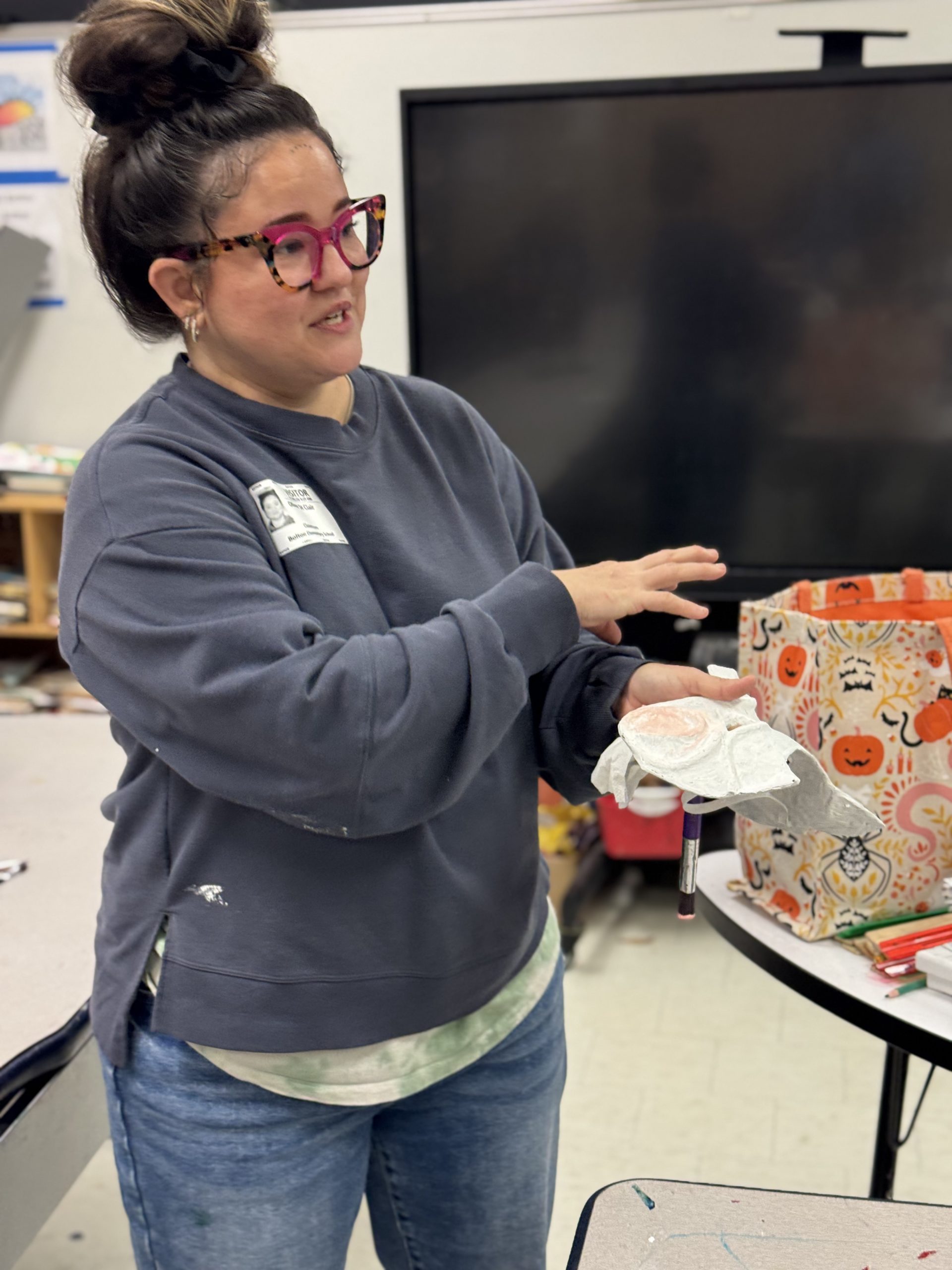
At the center of this transformation was Oliver St. Clair, an artist-teacher whose presence in the classroom is quiet, focused, and deeply observant. Teaching alongside Georgio Sabino, Oliver worked with sixth- and eighth-grade students at Bolton to create papier-mâché masks initially inspired by The Lion King, planned for a March performance. The work, however, did what real art always does—it expanded.
Some students followed the lion’s mane and structure closely. Others felt the pull to branch off, to reshape the form, to invent new colors, new expressions, new identities. Rather than rein them in, Oliver and Mr. Sabino leaned in. She understood that structure and freedom are not opposites—they are partners.
“We’ve been working on this since October,” Sabino reminded the class, grounding the moment in time and discipline. Art, here, was not rushed. It was earned.
Teaching the Process, Not Just the Product
Oliver’s teaching at Bolton focused on process literacy—helping students understand why each step mattered. Construction came first: planning the mask shape, building the armature, learning how balance and symmetry affect form. Then came taping, tearing paper by hand to feel its grain, mixing wheat paste and noticing its chemical change, layering patiently, allowing time to dry. The young scholars has to get use to the feel of wet wheat paste. Can you hear the squeals and ehhh’s.
When Mrs. Oliver was not there, this was science in action. Ratios mattered. So did timing. Math appeared in measurements, proportions, and repetition. Writing entered through reflection—students documenting what worked, what didn’t, and what they would try next.
Oliver moved from table to table, noticing who needed encouragement, who needed challenge, who needed quiet reassurance. She paid attention to detail not only in the artwork, but in the students themselves—the way one hesitated before committing color, the way another worked fearlessly, improvising with embellishments. The gifted artists and the less fortunate; but the less become more each time they came back to the classroom.
“She’s a super hero,” Sabino said, without exaggeration to students. “Highly recommended. Deeply motivated. And she’s in the schools doing the work.”
Watching Art Become Itself
As layers accumulated, so did confidence. Both teachers watched students’ eyes grow larger as the masks began to take shape—flat paper becoming dimensional, imagined ideas becoming tangible objects. Joy appeared not as noise, but as focus. Students asked to stay longer. Cleanup became a negotiation.
Sabino sharpened pencils and gathered written reflections. Oliver passed out scissors and paintbrushes, helping sabino set up water cups, modeling care for tools and space. When it was time to clean, there was reluctance—not because the work was unfinished, but because it mattered.
Each mask told a different story. Some were bold and regal, echoing lions. Others were abstract, emotional, experimental. Every student could explain their choices. Every student could point to a moment where something “went wrong” and became better.
Georgio repeated what he tells all his classes: “You cannot make a mistake in art—just make it better. Make the mistake part of the process. Don’t get stuck. Keep going.”
Oliver embodied this philosophy. Her own artistic practice—rooted in fiber, paper, symbolism, and vulnerability—translated seamlessly into teaching. Without lecturing, she modeled patience. Without controlling, she guided. She helped students see that art is slow for a reason, and that growth happens in layers.
A Classroom That Remembers
By the end of the session, Bolton Elementary held more than masks. It held evidence of listening, collaboration, and trust. Students had learned how to plan, how to adapt, how to observe change over time. They learned that their ideas mattered—and that discipline makes freedom possible.
Oliver St. Clair did not center herself in the room. She centered the students. And in doing so, she left an imprint far more lasting than papier-mâché: a belief that art is a way of thinking, a way of learning, and a way of becoming.
At Bolton, that belief took shape—slowly, deliberately, beautifully—one torn piece of paper at a time.
Nana Kwesi Georgio Sabino Painting “Essence of Beauty”
In a moment that felt like history converging with the present, the collaborative work of Georgio Sabino III and Ghanaian abstract pioneer Nana Kwesi Agyare-Ansah has emerged not merely as an exhibition but as a compelling story of artistic dialogue and cultural resonance. What started as intersecting paths between two visionary creators has become a body of work that transcends traditional boundaries of painting, textile, and narrative — ripe for appreciation in global capitals of art such as Paris (e.g., at spaces like Galerie Le Feuvre & Roze or Galerie Laure Roynette within the vibrant contemporary scene of the Marais) , Los Angeles (at forward-looking venues such as Kohn Gallery or curator-driven platforms like Coagula Curatorial) , and New York City (at pioneering Black-owned institutions such as Skoto Gallery and Calabar Gallery). Purchase Here
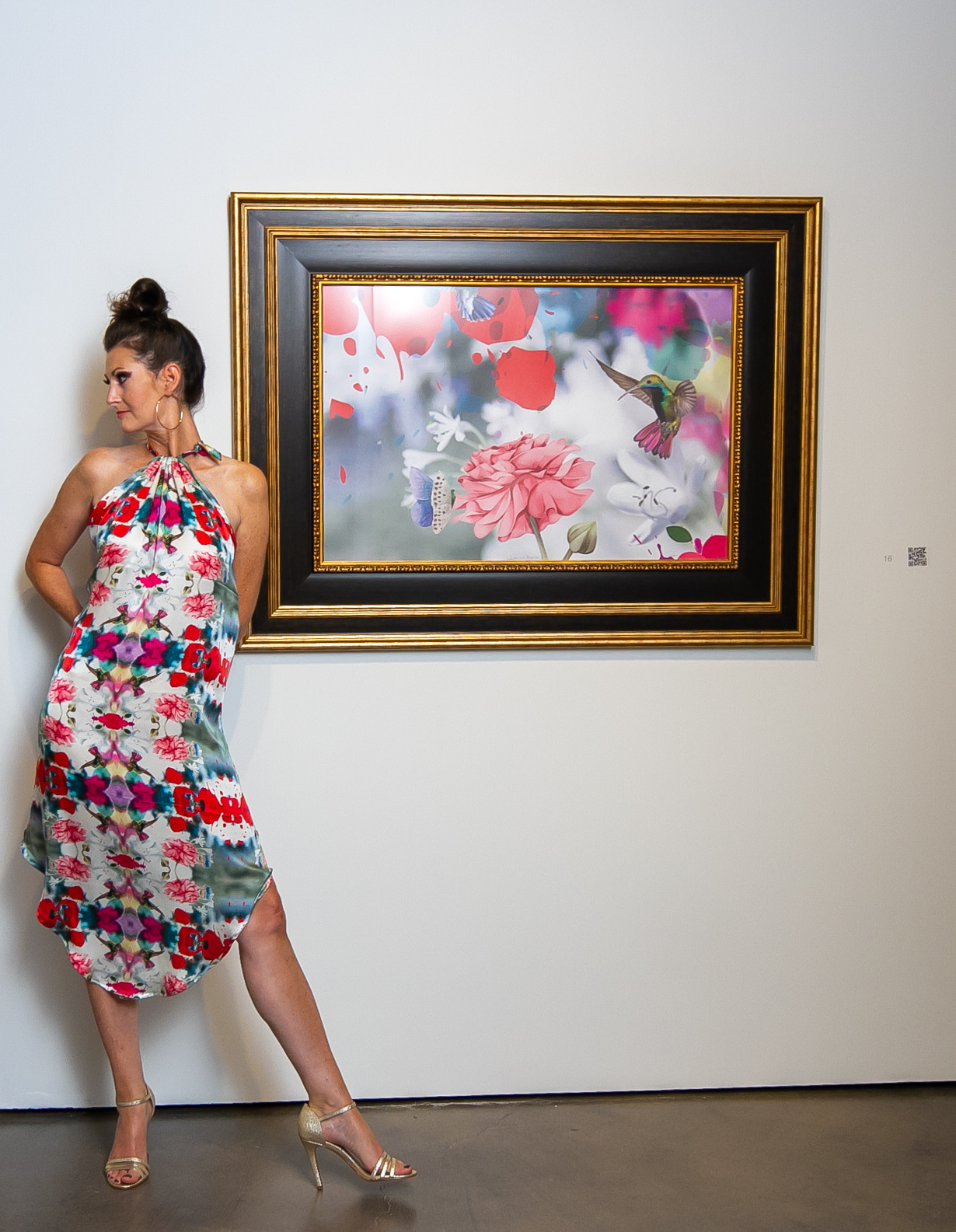
At the heart of this collaboration lies a shared curiosity about form, color, and identity. Sabino’s practice traverses photo-based painting and textile design — creating dynamic acrylic and silk/satin surfaces that come alive with both physical dynamism and augmented reality elements, extending the sensory experience of his work beyond the canvas into interactive realms . His textiles — printed silks that echo motifs of nature and human pattern — become wearable paintings: dresses, necklaces, bracelets, and earrings that carry Sabino’s imagery into the realm of couture.
Agyare-Ansah, known professionally simply as “Kwesi Agyare”, brings over two decades of abstract innovation rooted in deep engagement with Ghanaian life and light, color, and emotion. Educated at Kwame Nkrumah University of Science and Technology (KNUST) and Ghanatta College, he harnesses bold, vibrant fields of color that explore contemporary Ghana, layering cultural commentary into visual form through deeply expressive gestural abstraction .
Their collaboration — a fusion of Sabino’s painted textiles and Agyare-Ansah’s abstract languages — is more than a meeting of styles: it is cultural symbiosis. Sabino’s fluid silks — floated into the painting as fabric and then woven through fashion — are integrated into Agyare-Ansah’s own painted gestures. The resulting works radiate with rhythm and narrative: Sabino’s textile becomes part of the painted form, and Agyare-Ansah’s abstraction simmers beneath and around the cloth’s printed images, generating a multi-sensory experience that embodies movement, memory, and materiality.
Necklaces and bracelets fashioned from Sabino’s fabrics — now threaded into Agyare-Ansah’s compositions — become ornaments of meaning, pointing to shared heritages of adornment, identity, and display. Earrings punctuate canvases like notes in a visual score. The work, seen in this light, conjures not only surface beauty but layered symbolic interplay. With GS3 hummingbirds comes the augmented reality (AR) floating in and around the dress as if she on the fashion runway!
This body of work — already captivating audiences in exhibitions in Cleveland and Akron — is now poised to enter a global conversation. In Paris, where institutions and galleries are actively foregrounding African and diaspora art alongside contemporary European work , this collaboration would find rich resonance. Los Angeles’ eclectic, curator-driven landscape — from established galleries to experimental spaces — would offer another stage for its technicolor energy . And in New York City, with its long tradition of African diaspora curators and collectors, the work would join dialogues shaped by decades of cross-cultural exchange .
Supporting this artistic journey are a constellation of advocates and curators — international art critics, diaspora curators, fashion curators, and technologists — all poised to lift this body of work into new dialogues. Their shared aim: not simply to exhibit images but to build bridges of understanding through color, cloth, and cosmopolitan creative vision.
In this emerging chapter, Sabino and Agyare-Ansah aren’t just showing art — they are weaving stories that speak across continents, histories, and material sensibilities — inviting audiences everywhere to see painting not simply as pigment on surface, but as textiles of culture, narrative, and insight.
Poster are now available:
Bulk: Printing in large quantities significantly reduces the per-poster cost. $75 (10 or more)
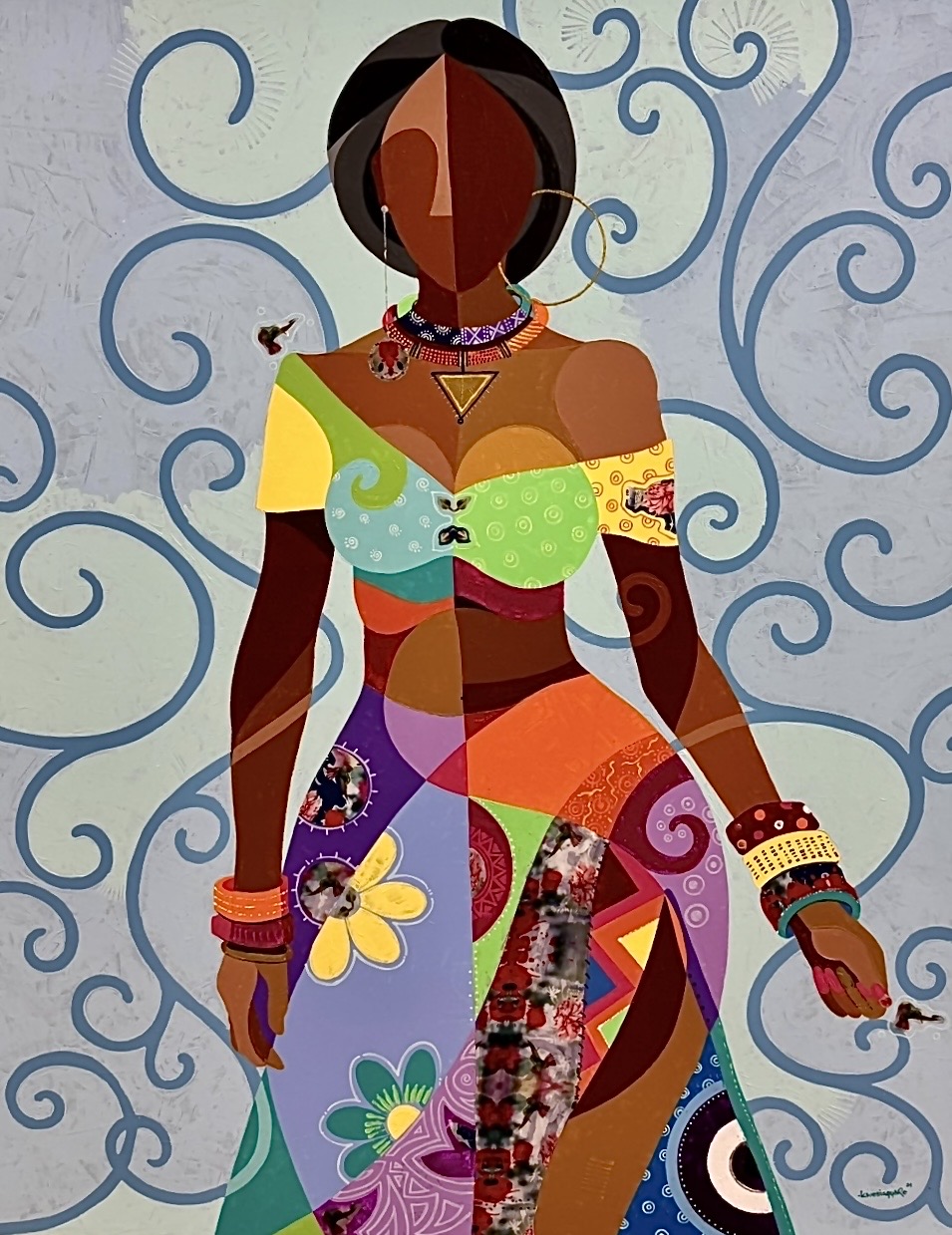
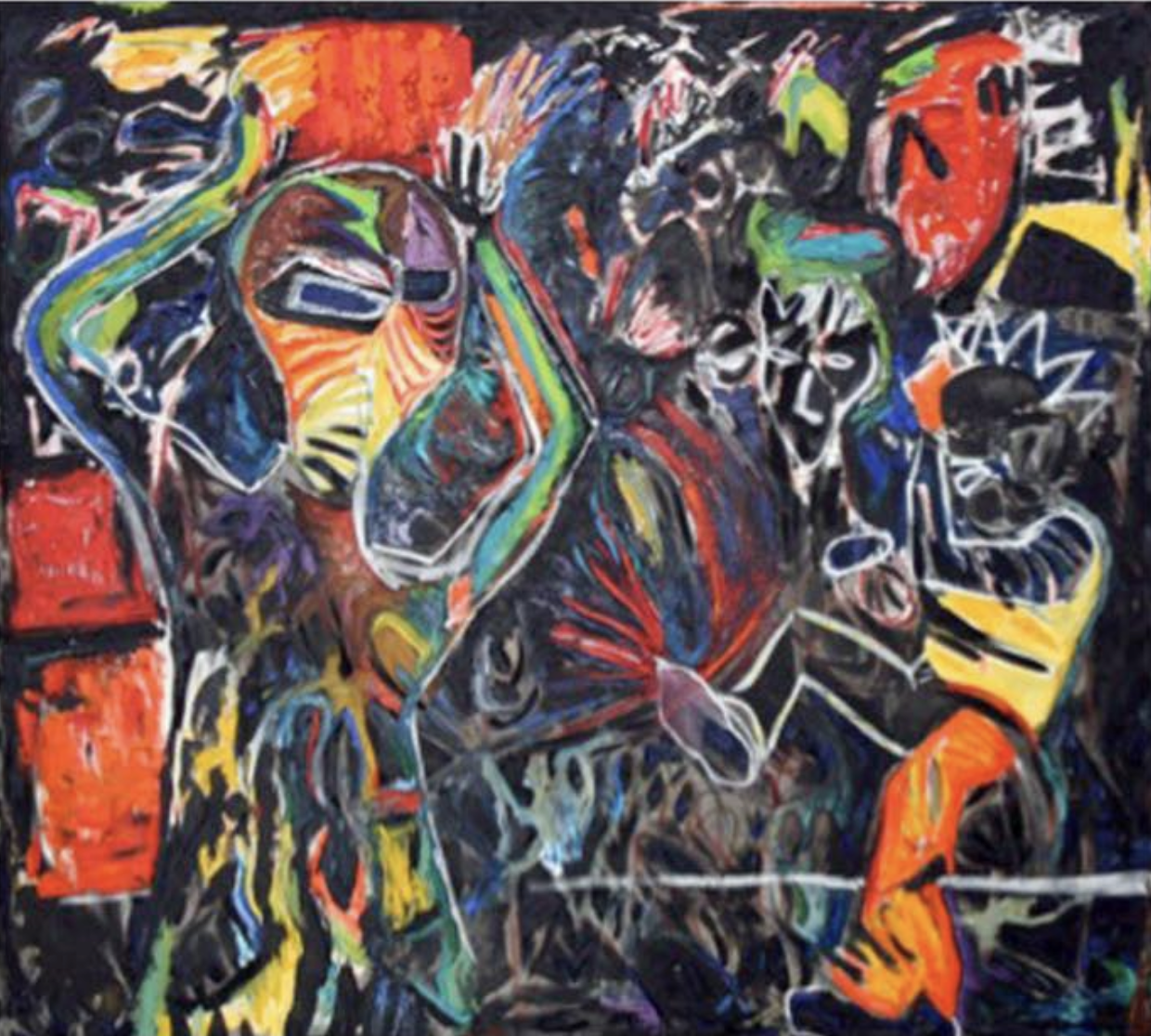
This collaborative painting presents a stylized, elongated female figure rendered in a rich fusion of abstraction, textile, and symbolic design. The figure stands poised and frontal, her body constructed from **interlocking planes of color warm earth tones, saturated reds, citrus yellows, turquoise, violets, and deep browns—creating a rhythmic patchwork that feels both architectural and fluid.
Visual Description
Nana Kwesi Agyare-Ansah’s hand is evident in the bold color blocking and abstracted anatomy. The face is intentionally faceless and mask-like, divided into tonal segments that resist portraiture and instead evoke universality and spirit. The background, filled with soft, swirling blue motifs, creates a lyrical counterpoint suggestive of wind, water, or ancestral movement allowing the central figure to breathe while remaining grounded.
Georgio Sabino III’s contribution appears through the silk and satin fabric embedded into the composition, particularly within the dress and adornments. These textile elements introduce photographic textures, floral imagery, and patterned fragments that shimmer against the painted surface. The silk is not decorative alone; it functions as narrative material memory, culture, and lived experience literally woven into the body of the figure. The jewelry necklace, bracelets, earrings also incorporates GS3 fabrics, transforming adornment into extension of the canvas.
Brief Art Critique
This work succeeds as a true collaboration, not a visual compromise. Nana Kwesi’s abstract language provides the structural and emotional framework, while Sabino’s silk interventions disrupt and enrich the surface with tactile complexity and contemporary flair. The result is a painting that oscillates between painting, fashion, and mixed media, collapsing boundaries between fine art and wearable art.
Conceptually, the piece speaks to Black femininity, elegance, and resilience without literal narration. The absence of facial features invites projection; the figure becomes collective rather than individual. The harmony between painted pigment and applied silk suggests dialogue between continents, generations, and disciplines.
Overall, this is a stunning, confident work that feels ceremonial yet modern, rooted yet forward-looking. It stands as a visual metaphor for collaboration itself: layered, respectful, and greater than the sum of its parts. A complete blend of fashion and art. Infusions of AI style with a 3D animation.
With a Dash of Flair… Georgio Sabino III, Art, Education, and the Power of Telling Our Own Stories
The National Association of Black Journalists (NABJ) has long stood as a national and international yardstick for excellence in storytelling, truth-telling, and cultural accountability. Inspired by the NABJ Convention and Career Fair ethos, the “With a Dash of Flair . . .” project—developed in collaboration with the Cleveland Public Library (CPL), The People’s University, and Cleveland Digital—centers Black journalists, artists, historians, and cultural workers whose lived experiences shape Cleveland’s past, present, and future.
At the heart of this installment is Georgio Sabino III, an American artist, educator, photographer, and cultural documentarian, interviewed by Dr. Regennia N. Williams, Associate Curator of African American Community Partnerships, Programs, and Traveling Exhibitions and Distinguished Scholar of African American History and Culture at the Cleveland History Center of the Western Reserve Historical Society. The project was captured by Catherine Young, Cleveland Public Library Videographer, whose visual storytelling anchors the interview in both scholarship and accessibility. (Video link included here in article)
As Dr. Nathan Carter once stated,
“I measure my work by what I think is a national, an international, yardstick.”
That philosophy resonates deeply throughout Sabino’s story—an artistic journey that refuses to play small, echoing the words of President Nelson Mandela:
“There is no passion to be found playing small— in settling for a life that is less than the one you are capable of living.”
Knowing Early: Art as Calling, Not a Hobby
Georgio Sabino III knew early—as early as 7th grade at Dominion Middle School—that he was an artist. This clarity was not accidental; it was instinctual. Art was not something he discovered later in life—it was something he recognized in himself.
His high school years were formative and complex. He spent some of his most joyful early years in Columbus at Whetstone High School, before relocating to Findlay High School, a move that proved unexpectedly transformative. Findlay offered one of the most comprehensive secondary arts programs in the region—spanning fashion design, interior design, jewelry making, alongside rigorous foundations in drawing, painting, ceramics, and design. That exposure reinforced Sabino’s belief that art was not only expressive—it was structural, intellectual, and professional.
Education as Foundation: Kent State, CWRU, and CIA
Sabino earned his Bachelor of Arts from Kent State University, an institution with deep historical ties to activism, design, and cultural inquiry. He later completed a dual master’s degree through a collaborative program between Case Western Reserve University (CWRU) and the Cleveland Institute of Art (CIA), focusing on Art Education.
His academic and professional work converged in a powerful body of work titled “Educational Genocide,” a series that critically examines systemic inequities in education—particularly how curriculum gaps, resource deprivation, and cultural erasure disproportionately impact Black and marginalized communities. The work is both visual and conceptual, combining research, symbolism, and lived experience.
As Jean-Michel Basquiat once asserted:
“Art is how we decorate space; music is how we decorate time.”
Sabino’s work does both—occupying space with intention while marking time with truth.
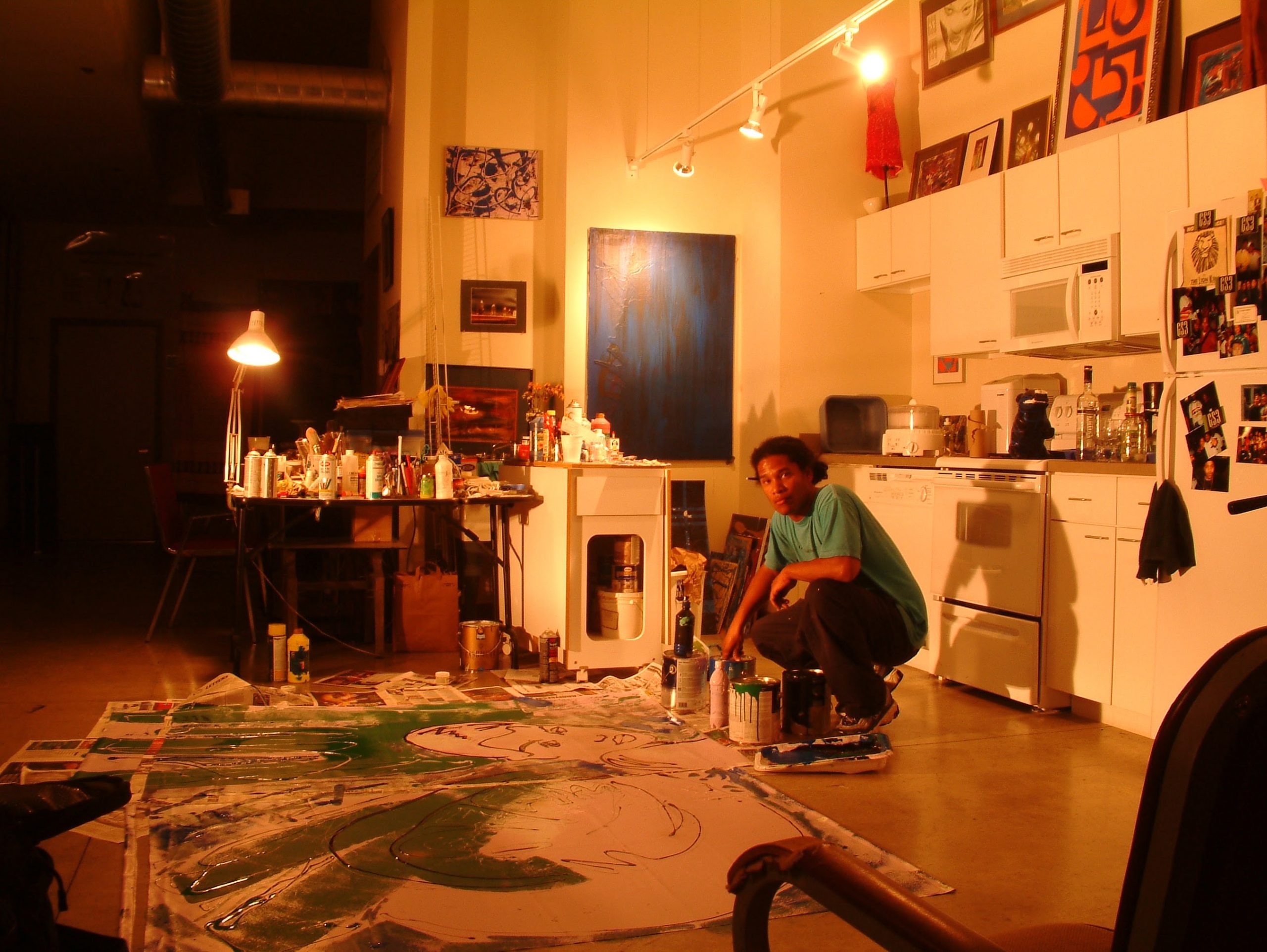
6’x6′ Oil Painting by Georgio Sabino III
From Fabric to Fashion: New York, SoulFire, and Early Recognition
For a brief but influential period, Sabino and business partner Richard Johnson II lived in New York City, where his clothing and designs were housed at SoulFire, a creative space curated by Lisa and Charles Woodward. During college, he hand-painted silk fabrics for fashion courses and showcased his work in fashion shows across New York and New Jersey—a period he describes as exciting, experimental, and formative.
These experiences expanded his understanding of art as interdisciplinary—where fine art, fashion, performance, and community intersect.
Returning to Cleveland: Tower Press and a City Buzzing
After returning to Cleveland, Sabino became part of a historic moment in the city’s arts revival. Under Mayor Michael R. White, he was among 20 artists awarded funding connected to a multi-million-dollar initiative to reinvigorate Cleveland’s cultural economy at Tower Press. The building became a creative epicenter, drawing tourists and residents every weekend.
Among the standout artists in the space were Hector Vega, Kathy Skerritt, and Bruce Conforti—figures whose work helped define the era. The city buzzed with exhibitions, conversations, and commerce—proof that investment in the arts yields cultural and economic returns.
Towerpress
Picking Up the Camera: A Self-Taught Evolution
It was during this Cleveland renaissance that Sabino picked up a camera, teaching himself photography from the ground up. While art was innate, photography required technical mastery—timing, light, shutter speed, and aperture—skills he layered onto his deep understanding of composition, already honed through painting and design.
Influenced by John Isaac of National Geographic and guided by mentorship and friendship from Bern Webb, Sabino set a bold goal early: to shoot as if every image were a magazine cover. That discipline led to publication in iconic outlets such as JET and Ebony, and eventually to touring nationally with Grammy Award–winning artists.
History in Motion: Sports, the White House, and Presidential Recognition
Sabino’s lens later captured historic sports moments, including the Ohio State Buckeyes’ first College Football Playoff National Championship (2015) and the Cleveland Cavaliers’ NBA Championship (2016)—both teams later honored at the White House.
In a defining moment, Sabino directly asked the Obama Administration for access, stating: “I am a small business, but I want to cover this big story.”
The request was granted—twice.
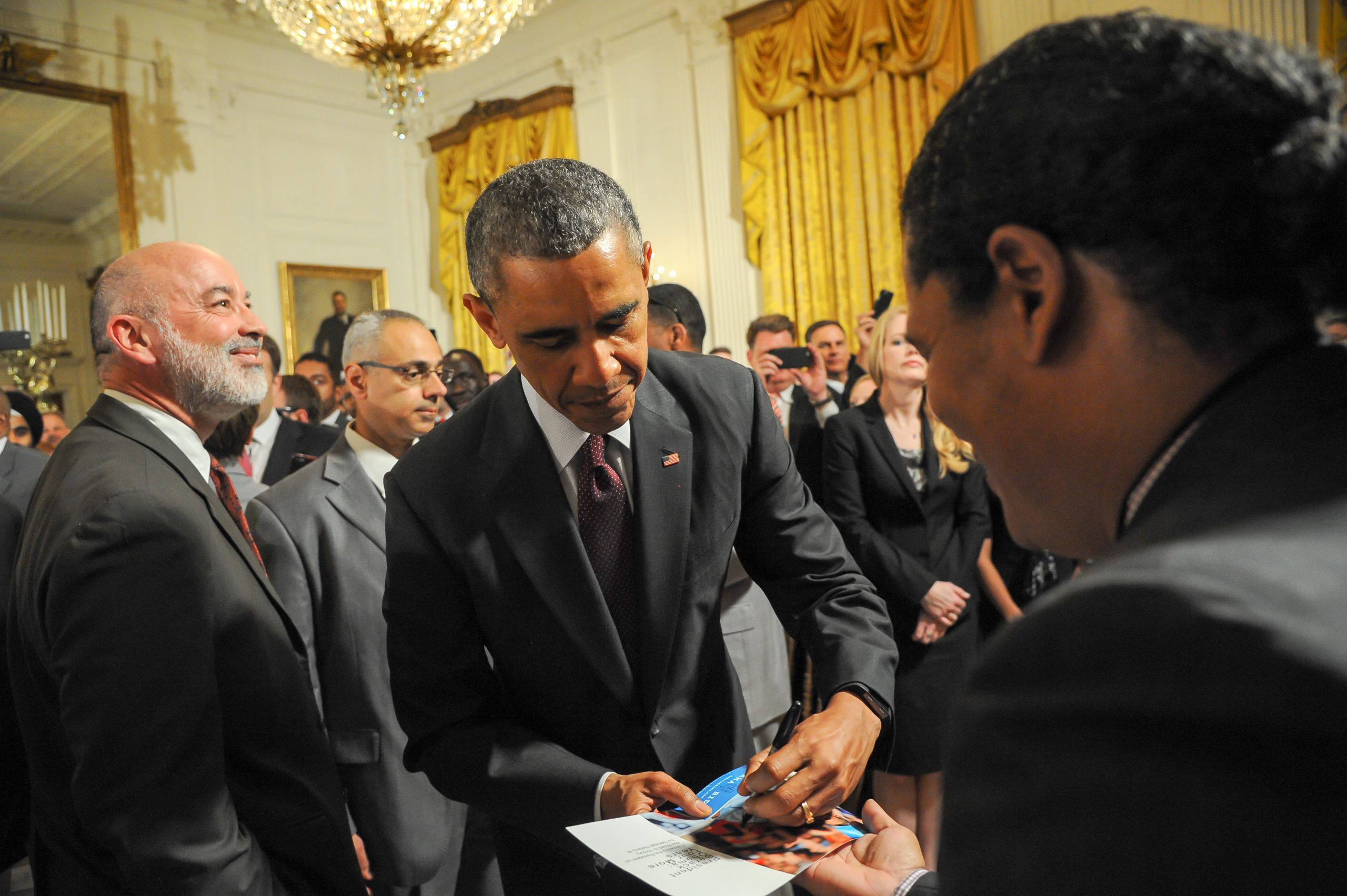
President Barack Obama personally signed Sabino’s artwork, recognizing his documentation of Obama’s journey from U.S. Senator through two presidential terms. Sabino has since published this body of work online, preserving it as both art and historical record.
PRESIDENT OBAMA signs a Ohio State University Buckeyes football team poster for GEORGIO SABINO III in honor of the team winning the first ever College Football Playoff National Championship The event took place in the East Room of the White House by @RickyFitchett
A Global Artist, A Local Responsibility
From photographing fashion in Paris, to traveling and working in Tanzania, Sabino’s career spans continents—but remains grounded in community. As contemporary artist Kehinde Wiley has stated:
“The question is not who is allowed to speak, but who is believed.”
Projects like “With a Dash of Flair…” answer that question by centering Black voices as authorities of their own narratives.
Watch, Reflect, and Engage
There is far more to Georgio Sabino III’s story than one article can hold. This interview is an invitation—to watch, to listen, and to engage with the living history of Cleveland through journalism, art, and education.
Watch the interview. Share your thoughts. Join the conversation.
The creative path of Georgio Sabino III, widely known as GS3, is a testament to artistic determination, cultural awareness, and a lifelong commitment to documenting human experience with clarity and power. His photography, design work, mentorship, and community activism have placed him at the intersection of art, history, and social engagement. Over decades, Sabino has built a career that bridges fine art, documentary photography, education, and creative leadership — a journey that continues to evolve as he steps into authorship and long-form visual storytelling.
Sabino’s journey began in galleries, studios, and local arts spaces where he sharpened his skills as both an observer and a creator. Early on, he developed a reputation for capturing the emotion, intensity, and rhythm of the world around him. Whether photographing dancers, musicians, athletes, activists, or everyday people, his images reveal a deep respect for the human spirit and a unique ability to freeze moments that vibrate with meaning. This sensitivity to gesture, presence, and timing would later elevate him onto national stages.
One of the most defining milestones of Sabino’s career came through two invitations from the White House during the Obama administration. He was selected as an official photographer for President Barack Obama’s celebrations honoring the Ohio State Buckeyes in 2015 and the Cleveland Cavaliers in 2016 — two championship moments of immense pride for the state of Ohio. These assignments placed Sabino behind the scenes and face-to-face with historic events, athletes, dignitaries, and President Obama himself. His ability to capture the spirit of triumph, camaraderie, and cultural significance in these moments solidified his reputation as a photographer capable of both technical mastery and emotional depth.
Sabino’s work, however, extends far beyond major events. His creative practice has taken him across Ohio and throughout the United States, documenting communities, celebrations, struggles, and artistic expression. He has photographed political campaigns, professional sports, urban life, emerging artists, cultural festivals, and historic events, each time with a commitment to authentic storytelling. His lens does not merely record moments; it interprets them. He finds the interplay between people and their environments, between emotion and circumstance, between history and the present tense. This instinctive awareness is what makes his photographs resonate long after the moment has passed.
In addition to his photographic accomplishments, Sabino is deeply connected to the world of education. His collaborations with the Studio Institute in New York have allowed him to bring arts engagement, creative thinking, and mentorship to students and emerging artists. Through lectures and workshops at Virginia Marti College of Art and Design, Ursuline College, and Cuyahoga Community College, Sabino has become a respected educator whose perspective blends practical skill-building with artistic exploration. He encourages students to understand not only technique, but also purpose — the reasons behind the image, the message being communicated, and the responsibility an artist carries when documenting real lives and communities.
Sabino’s leadership also extends into civic and cultural roles. He has served as an art juror for influential leaders including Congresswoman Stephanie Tubbs Jones, Congresswoman Marcia Fudge, and Congresswoman Shontel Brown. These experiences allowed him to support artists, evaluate creative work, and participate in shaping cultural initiatives with national and regional impact. His commitment to elevating artistic voices is mirrored in his service on the Kent State University board as President of the Black chapter, where he advocated for equity, representation, and opportunities for students of color.
Throughout his journey, Sabino has remained dedicated to community engagement. His work with local organizations, nonprofits, cultural institutions, and creative collectives has helped raise visibility, strengthen outreach, and build connection. Sabino’s creative strategies and visionary leadership have positioned him as more than a photographer — he is a connector, collaborator, and cultural architect. He views art as both a mirror and a guide, a way to reflect who we are while inspiring who we might become.
What makes Sabino’s story especially compelling is the way he weaves personal purpose with historical awareness. His photography often intersects with major moments in American life, from sports victories to political milestones. Over the years, his camera has served as witness to events that have shaped the cultural landscape of the nation. Yet Sabino remains grounded in the belief that every photograph matters, whether it is taken in a quiet neighborhood or a grand national stage. His images reveal a consistent vision: a desire to honor people’s humanity, resilience, and individuality.
As technology, culture, and creative industries evolve, Sabino continues to adapt and expand his artistic voice. His design work, fashion collaborations, digital art, and multimedia projects demonstrate a willingness to push boundaries and explore new forms of expression. He approaches creativity not as a single discipline but as a network of interconnected possibilities. Photography is his foundation, but storytelling is his mission.
Today, Sabino steps into a new chapter as an author, transforming his photographic archives into written and visual narratives that capture both the moment and the meaning behind it. His published work allows readers to experience history, art, and personal reflection woven together into cohesive storytelling. Through books that document political journeys, community life, artistic evolution, and personal milestones, Sabino invites audiences into the worlds he has observed and the experiences he has lived.
One of the most personal and powerful elements of Sabino’s story is the evolution of his relationship with his own art. The act of documenting history is not simply technical for him; it is emotional, cultural, and deeply human. Moving into authorship allows him to articulate these dimensions in fuller form. A book becomes both archive and testimony — a way to preserve memory, honor people and moments, and offer insight to future generations.
Sabino’s transition into authorship also reflects a broader commitment to legacy. Through his lens, he has witnessed triumphs, transformations, and turning points. Through his words, he now contextualizes these experiences, sharing what it meant to stand in those spaces, frame those images, and participate in those chapters of American life. It is this combination of visual power and reflective narrative that gives his work its enduring value.
At the core of Sabino’s creative life is a belief in possibility — the possibility of art to influence thought, the possibility of images to spark emotion, and the possibility of storytelling to shape understanding. His career represents what can happen when talent meets dedication, when opportunity meets preparation, and when an artist commits not only to the craft but to the communities and histories connected to it.
As GS3 continues to build on his legacy, his work reminds us that art is more than observation; it is participation. His images do not simply capture events — they illuminate them. They invite viewers to feel the energy of a championship celebration, the dignity of a public figure, the vibrancy of a cultural gathering, or the quiet intensity of a personal moment. Sabino’s photography is both an act of witnessing and an act of honoring.
With decades of experience, a deep creative portfolio, and a renewed dedication to long-form storytelling, Georgio Sabino III stands as an artist whose voice continues to expand in purpose and reach. Through photography, design, arts education, and now authorship, he offers a body of work that is visually striking, culturally meaningful, and deeply rooted in community. His lens has shaped how history is remembered; his words now help shape how it is understood.
As he publishes new works, teaches new students, collaborates with new institutions, and continues to document life across the country, Sabino carries forward a legacy built on vision, integrity, and the belief that art has the power to transform. His story — and the stories he captures — embody resilience, creativity, and the enduring spirit of possibility.
From the electrifying moment a young Illinois senator stepped onto the national stage to his historic inauguration, this memoir-photography book chronicles one artist’s eyewitness journey through a campaign that changed America. As Senator Barack Obama rose to national prominence — beginning with his keynote address at the 2004 Democratic National Convention — Georgio Sabino III began following the story not as a bystander but as a documentarian, photographing the people, places, and private moments behind a movement. (Wikipedia) Link to the book Here
Over the course of the 2007–2008 campaign and the consequential election on November 4, 2008, Sabino captured the energy, the setbacks, and the triumphs of a candidacy that culminated in the first African American elected President of the United States. These images and first-person accounts trace the campaign trail — rallies, strategy spaces, late-night conversations, and the human faces of hope — offering readers both visual immediacy and contextual narrative. (Wikipedia)
The book culminates in the inauguration and the solemn transfer of power on January 20, 2009, a day that marked a profound national milestone and is remembered around the world. Sabino’s photographs from that period — paired with his reflections and carefully researched historical notes — place his work within the broader political and cultural significance of the moment. (Wikipedia)
Included here are never-before-published photographs, behind-the-scenes anecdotes, and an intimate account of an unforgettable personal moment: President Barack Obama signing Sabino’s artwork. That signature — a tangible acknowledgment from the nation’s highest office — became for the artist a profound symbol of validation, pride, and the power of the arts within civic life. Sabino reflects on why that encounter mattered, both personally and as part of a larger story about recognition, representation, and American democracy.
The First Black American President: Obama & GS3 is at once a visual archive and a thoughtful testament — a book for history lovers, students of political culture, and anyone moved by the intersection of art and public life. Detailed captions, contextual timelines, and carefully checked historical references make this volume a reliable resource as well as a moving tribute to a singular chapter in American history. (The American Presidency Project)
This book captures my journey as photographer Georgio Sabino III GS3 as I followed Barack Obama from senator to the first Black American President. Through determination and a belief in the power of history I documented the national campaign from early rallies to the night America chose a new direction. Each photograph reflects the energy hope and movement that inspired millions. This work is both a personal record and a visual testimony to a turning point in our nation. One unforgettable moment was President Obama signing my artwork a gesture that filled me with pride honor and validation. It symbolized the value of art the importance of storytelling and the power of representation. This collection preserves the scenes emotions and experiences that shaped an extraordinary chapter in American history and my own life. It stands as a tribute to leadership progress and the spirit of possibility.
The First Black American President: Obama & GS3
PRESIDENT OBAMA signs a Ohio State University Buckeyes football team poster for GEORGIO SABINO III in honor of the team winning the first ever College Football Playoff National Championship The event took place in the East Room of the White House Photo Credit: Ricky Fitchett – WhiteHouse Photographer
A Quinceañera is more than a celebration—it is a rite of passage, a cultural milestone, and a moment where family history, tradition, pride, and joy come together. Families invest time, love, and resources into the dress, the venue, the choreography, and the spiritual and cultural rituals that make the day unforgettable. But what truly preserves these memories for generations is professional photography.
That’s where Georgio Sabino III of GS3 Photography stands out.
Experience That Matters: 350 Weddings + Countless Events
With over 350 weddings and numerous major events captured, Georgio brings a level of expertise and artistic depth that only comes from experience. Families choosing GS3 aren’t just hiring a photographer—they’re hiring a qualified, certified professional who understands how to document culture with respect, beauty, and storytelling.
In Black and Afro-Latinx communities especially—where photography has historically been a tool of both empowerment and preservation—having images created by someone who values cultural identity matters. Georgio approaches each assignment with care, ensuring every family feels seen, honored, and beautifully represented.
Understanding the Price Range
Quinceañera photography varies widely depending on what families want. (And families deserve full transparency.)
Basic or beginner packages can start under $1,000
Professional full-day coverage typically ranges $2,500–$4,500 or more
These differences reflect:
Experience and training of the photographer
Hours of coverage needed
Pre-event sessions (such as formal portraits or family photos)
Albums, prints, or wall art
Videography options
Editing style and artistic approach
What families get with GS3 Photography is not just coverage—it’s craftsmanship, art, and an understanding of how important representation is in milestone events.
What Sets Georgio Sabino III Apart
GS3 Photography delivers:
Artistic, long-lasting images designed to be cherished for generations
Professional lighting, composition, and editing
Cultural awareness, ensuring traditions, families, and details are honored
A storytelling approach, creating albums that feel like cinematic narratives
A calm, guiding presence, invaluable during a long, emotional day
In Black communities and across the African diaspora, photography has long been a way to reclaim identity, celebrate joy, and archive family stories that were once denied or erased. Georgio brings that same reverence to every Quinceañera he photographs—celebrating culture through an artistic, respectful lens.
Why Investing in Quality Photography Matters
Years from now, the food, the music, and even the dress may fade—but the photos remain. They become heirlooms. They become history. They become the images future generations use to understand who they are and where they come from.
Hiring a seasoned professional like Georgio ensures those memories are preserved with beauty, clarity, and artistic excellence.
Planning a wedding is all about choosing the right team—people who will capture your love story, elevate your celebration, and help create memories you’ll treasure for a lifetime. At GS3 Photography, led by award-winning photographer Georgio Sabino III, we bring over 350 weddings of experience from the East Coast to the West Coast—from Atlanta’s vibrant celebrations to intimate weddings right here in Cleveland, Akron, Columbus, and all across Ohio. Every culture, every tradition, every love story—we’ve photographed them all with passion and respect.
But we didn’t stop at photography. We partnered with the legendary DJ Ronny Knight, whose energy, professionalism, and style transform receptions into unforgettable parties. And together, GS3 offers the complete wedding package: drone coverage, cinematic video, fine-art photography, and top-tier DJ entertainment—a seamless, high-quality experience built for modern brides, grooms, wedding coordinators, and event planners.
What makes our team stand out? The reviews speak for themselves. Couples rave about our creativity, coordination, and calm presence on the biggest day of their lives. We capture candid emotion, grand entrances, family moments, culture, joy, and everything in between—while Ronny Knight keeps the celebration flowing with perfectly curated music. And with our drone footage, we take your story to new heights, literally, delivering breathtaking views that turn your wedding film into a cinematic masterpiece.
Whether you’re in Cleveland, Columbus, Akron, Canton, Atlanta, Los Angeles, New York City, or anywhere across the country, GS3 Photography & DJ Services is designed to meet your vision with excellence. Our all-in-one packages save you time, reduce stress, and guarantee a polished, cohesive look across photo, video, and entertainment.
If you’re ready for a wedding day that looks and feels extraordinary— read our reviews, explore our packages, and let GS3 + Ronny Knight bring your celebration to life. Your story deserves art. Your reception deserves energy. Your memories deserve GS3.
Presented by the Western Reserve Historical Society at the MLK Branch of Cleveland Public Library
Cleveland’s creative community gathered for a night of rare insight, history, and artistic electricity as award-winning filmmaker Robert C. Banks, Jr. took the stage for an in-depth conversation moderated and hosted by Georgio Sabino III. The program, part of the Western Reserve Historical Society’s commitment to documenting and uplifting the region’s cultural voices, blended cinema, music, and live discussion into a uniquely immersive experience. View Film
A Historic Evening Framed by Dr. Regennia N. Williams
The night opened with a powerful and elegantly delivered introduction by Dr. Regennia Williams, who framed Banks’ career within Cleveland’s broader legacy of Black artistic excellence. She highlighted his decades-long journey as an experimental filmmaker — from hand-processing 16mm film to teaching at CSU and mentoring young artists throughout the region.
Her remarks set the tone: this would not merely be a film talk, but a historical conversation.
Live Jazz Meets Experimental Film
Before the dialogue began, the audience was treated to a remarkable fusion of sound and image — a live jazz ensemble performing to one of Banks’ experimental films. The improvisational soundtrack breathed new life into his moving images, creating a kinetic energy that felt both vintage and avant-garde.
It was a celebration of process, play, and the jazz-like rhythm that echoes through so much of Banks’ work.
A Deep Dialogue Between Artists
When host Georgio Sabino III joined Robert Banks on stage, the crowd quickly realized they were witnessing something special. The conversation was an intellectual sparring match — respectful, creative, and profoundly curious. Sabino guided the discussion through Banks’ early days shooting 16mm in Cleveland, his experiences working entirely by hand, the challenges of the independent film landscape, and the move into digital formats.
Banks spoke candidly about the discipline, patience, and emotional intelligence required to create cinema outside of the mainstream system. The audience listened intently as he shared stories about assembling films frame-by-frame, the labor of preserving analog work, and his commitment to teaching new generations of filmmakers at CSU and throughout local Cleveland high schools.
Behind the Scenes: The Contributions of Andre Cato
Working alongside Georgio throughout this production was Andre Cato, serving as assistant and director of the filmed portion of the evening. Cato’s steady eye, thoughtful framing, and intimate understanding of both artists allowed the conversation to be documented with precision and artistry. His role ensured that the event was captured not just as documentation, but as living visual storytelling — aligned with the spirit of Banks’ own cinematic philosophy.
Together, Sabino and Cato formed a modern creative duo: one leading the conversation in real time, the other shaping its lasting visual narrative.
A Night of Wisdom, Laughter, and Legacy
What made the evening unforgettable was Banks himself — candid, humorous, sharp, and brimming with lived experience. Audience members often nodded, laughed, and scribbled notes as he shared hard truths about the filmmaking process and the dedication required to preserve an authentic artistic voice.
It was clear that this gathering represented something larger: A passing of knowledge. A recognition of Cleveland’s artistic heritage. A celebration of experimental cinema as a living art form.
The Take: A Cultural Moment Worth Preserving
“Jazzed About Photography: Robert Banks” stands as one of the Western Reserve Historical Society’s most engaging conversations to date — a perfect intersection of film, music, history, and community exchange. With the combined leadership of Georgio Sabino III, the artistic support of Andre Cato, and the cultural stewardship of Dr. Regennia Williams, the evening honored both the legacy and the ongoing evolution of Cleveland’s film scene.
For those who attended, it was more than an event — It was a masterclass in creativity. A celebration of Black artistry. And a reminder of how powerful Cleveland’s cultural voices truly are.