When Georgio Sabino III (GS3) traveled from Cleveland to Washington, D.C., he carried more than equipment, notes, and professional responsibilities. He carried a question:
How can the visual history of Northeast Ohio’s artists—those who came before us and those creating today—be preserved, shared, and made accessible to future generations?
As a visual lead, artist, subcontractor, and co-curator connected with the RASHAD Center and the Western Reserve Historical Society, Georgio entered a partnership rooted in cultural memory. His work centered on identifying Cleveland-based artists, past and present, and helping bring their artwork into a digital environment where the public could encounter it beyond the walls of a museum or archive.
The Western Reserve Historical Society is a Smithsonian Affiliate and a major steward of Northeast Ohio history. Itscollections include documents, photographs, art, artifacts, audio, and video. The society’s African American Archives,established in 1970, were created to preserve and make accessible materials related to African American life, history,and culture in Northeast Ohio. Its digital initiatives continue that mission by giving the public new ways to explore theregion’s stories.
For Georgio, the assignment was not simply about scanning artwork or transferring images into a database. It was aboutrecognizing artists as historians in their own right.
Every painting, photograph, design, mural, sketch, and mixed-media work carries evidence of a time and place. It canreveal how people saw their neighborhoods, celebrated their communities, responded to injustice, imagined the future, ormade beauty from difficult circumstances. To digitize that work responsibly is to protect more than an image. It is topreserve the artist’s voice, intention, labor, and connection to Cleveland.
A First Taste of Washington
Georgio’s Washington experience began with a moment of stillness at Café du Parc, the French brasserie at the Willard InterContinental on Pennsylvania Avenue. The café is known for its French pastries, coffee, and classic dishes, withviews toward Pershing Park and the lively streets of the nation’s capital.
There, over an exquisite dessert and coffee, he watched Washington move through the windows—visitors, workers,residents, and travelers crossing paths beneath the vivid light of the city.
It was an appropriate beginning.
The café offered a pause before the work intensified: a chance to observe, reflect, and understand that cities are livingarchives. Cleveland and Washington may be separated by distance, but both are shaped by movement, memory, art, andthe people who give their communities meaning.
Georgio’s goal was clear: to learn, understand, and share the experience.
Entering a National Conversation
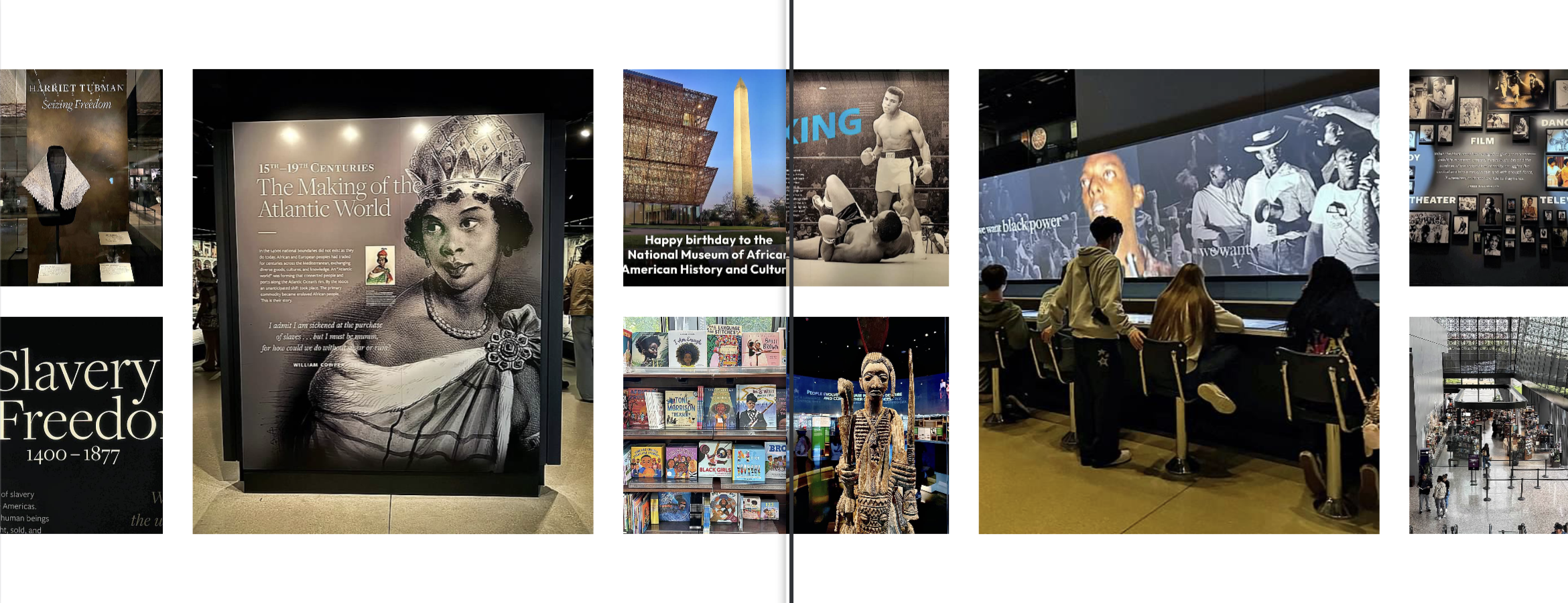
The Smithsonian’s National Museum of African American History and Culture offered Georgio an extraordinaryopportunity to study how a national institution presents history to the public. The museum does not treat history as acollection of isolated objects. It connects artifacts to people, movements, music, faith, art, labor, family, resistance, andimagination.
Walking through the museum, Georgio paid attention not only to the objects on display but also to the way the museumcommunicated their meaning. He observed how artifacts were positioned, how photographs and documents werecontextualized, how digital elements extended the visitor experience, and how personal stories helped transform historyfrom something distant into something intimate.
The visit became a lesson in curation.
To curate is to make choices: what to preserve, what to place beside something else, what context to provide, and how toinvite the public into the story. To digitize is to extend those choices into another form—one that can reach students,families, researchers, artists, and communities who may never have the opportunity to visit Washington or Cleveland inperson.
That understanding was especially important to Georgio’s work with Cleveland artists. A digital collection should notflatten the work into isolated files. It should help viewers understand the artist, the community, the historical moment,and the creative tradition surrounding each piece.
Learning Through People, Music, and Ideas
The anniversary programming brought together artists, scholars, cultural workers, performers, museum professionals,and collaborators from across the country. Sabino listened to speakers and lectures, studied the museum’s interpretivemethods, and connected with people who approach history through different creative and professional disciplines.
He also participated fully in the celebration.
At the gala, music and conversation created an atmosphere where history and contemporary culture met. Performers andentertainers—including Jermaine Dupri, Bill Bellamy, and the artist known as Da Brat, as described in Georgio’saccount—helped turn the anniversary into a living celebration rather than a formal remembrance alone.
He networked, danced, listened, and exchanged ideas. Those moments mattered because cultural preservation iscollaborative work. A museum may hold the collection, but its meaning grows through the people who interpret it,question it, perform it, research it, and carry it back into their communities.
For Georgio, the gathering demonstrated that museums are not silent buildings. They are meeting places—spaces wherethe past speaks to the present and where new partnerships can begin.
The Cleveland Connection
The journey from Cleveland to Washington was also a journey back to Cleveland’s own artistic history.
The purpose of Georgio’s role was to help identify and amplify Cleveland-based artists across generations. Some artistsare well documented. Others may be known primarily through family photographs, neighborhood stories, communityexhibitions, independent publications, private collections, or the memories of people who worked beside them.
That is where visual leadership becomes essential.
GS3’s responsibility was not only to recognize compelling artwork. It was to help build a process for locating,documenting, organizing, and presenting it. The work requires conversation with artists, families, collectors, historians,community organizations, and archives. It also requires care: confirming names and dates, recording provenance,preserving original context, and making sure that artists and communities are represented accurately.
The goal is not to separate “past” artists from “present” artists. It is to show continuity.
A contemporary Cleveland artist may be responding to visual traditions developed decades earlier. A younger artist maybe carrying forward a language of color, portraiture, abstraction, storytelling, protest, or community documentationshaped by artists who came before. When these works are placed into conversation, Cleveland’s creative historybecomes visible as a living continuum.
Digital Preservation as Public Service
Digitalization can make cultural history more accessible, but the technology is only one part of the work. The deeperresponsibility is interpretation.
A strong digital record may include:
- A high-quality image of the artwork
- The artist’s name and dates, when known
- The title, medium, and dimensions
- The date or approximate period of creation
- Ownership and provenance information
- A description of the work
- The neighborhood, organization, or community connected to it
- Oral histories or statements from the artist and family
- Information about copyright and permitted public use
These details allow an image to remain connected to its story.
WRHS describes its Digital Cleveland Starts Here initiative as a way for the public to access digital collectionscontaining images, audio, video, and text. That model reflects the importance of making regional history available notonly inside museum galleries but also through online learning and research.
For GS3, this approach offered a powerful vision: a Cleveland student could encounter the work of a local artist online; afamily could discover a relative’s creative legacy; a researcher could study patterns across decades; and a living artistcould see their work placed within the broader history of Northeast Ohio.
A Visual Lead with a Larger Purpose
Georgio Sabino III’s role as visual lead was therefore both practical and cultural. He helped connect artistic vision withhistorical responsibility.
He looked closely at how the Smithsonian organized objects, built narratives, and used digital tools to share knowledge.He listened to specialists and collaborators. He paid attention to the visitor’s experience: what draws the eye, whatcreates emotional connection, what clarifies context, and what encourages people to keep learning.
He also understood that visual work can open doors that formal language sometimes cannot.
An image can invite a visitor into a story. A portrait can restore individuality to someone remembered only as a name. Amural can reveal the spirit of a neighborhood. A digital archive can allow a work of art to travel across time andgeography.
From the streets of Columbus to Cleveland to the galleries of Washington, Georgio’s experience became a study in howcommunities preserve themselves.
Carrying the Work Forward
The most meaningful part of the trip was not simply seeing a national museum or attending an anniversary celebration. Itwas returning with a deeper sense of purpose.
Georgio came to understand that the work of cultural preservation is never finished. Each generation must decide what itwill protect, what it will teach, and whose stories it will make visible.
His experience with the Smithsonian and the Western Reserve Historical Society strengthened his commitment toCleveland artists—those whose work has already shaped the region and those whose work is shaping its future. As avisual lead and co-curator, he stands at the meeting point of art, history, technology, and community.
The journey reminded him that Cleveland’s creative legacy is expansive. It lives in galleries and studios, but also inhomes, churches, schools, streets, archives, family albums, and community spaces. It lives in the hands of artists whocreated without national recognition and in the vision of those creating today.
To digitize that history is to say:
Your work matters. Your story belongs in the record. Your creativity is part of the history of this place.
And to share it with the public is to give that history a future.
GS3’s trip from Cleveland to Washington DC was not only a professional assignment. It was a passage between localmemory and national recognition—a chance to learn from one of the country’s most important cultural institutions andbring that knowledge home.
He traveled as a visual lead.
He returned as a bridge-builder.