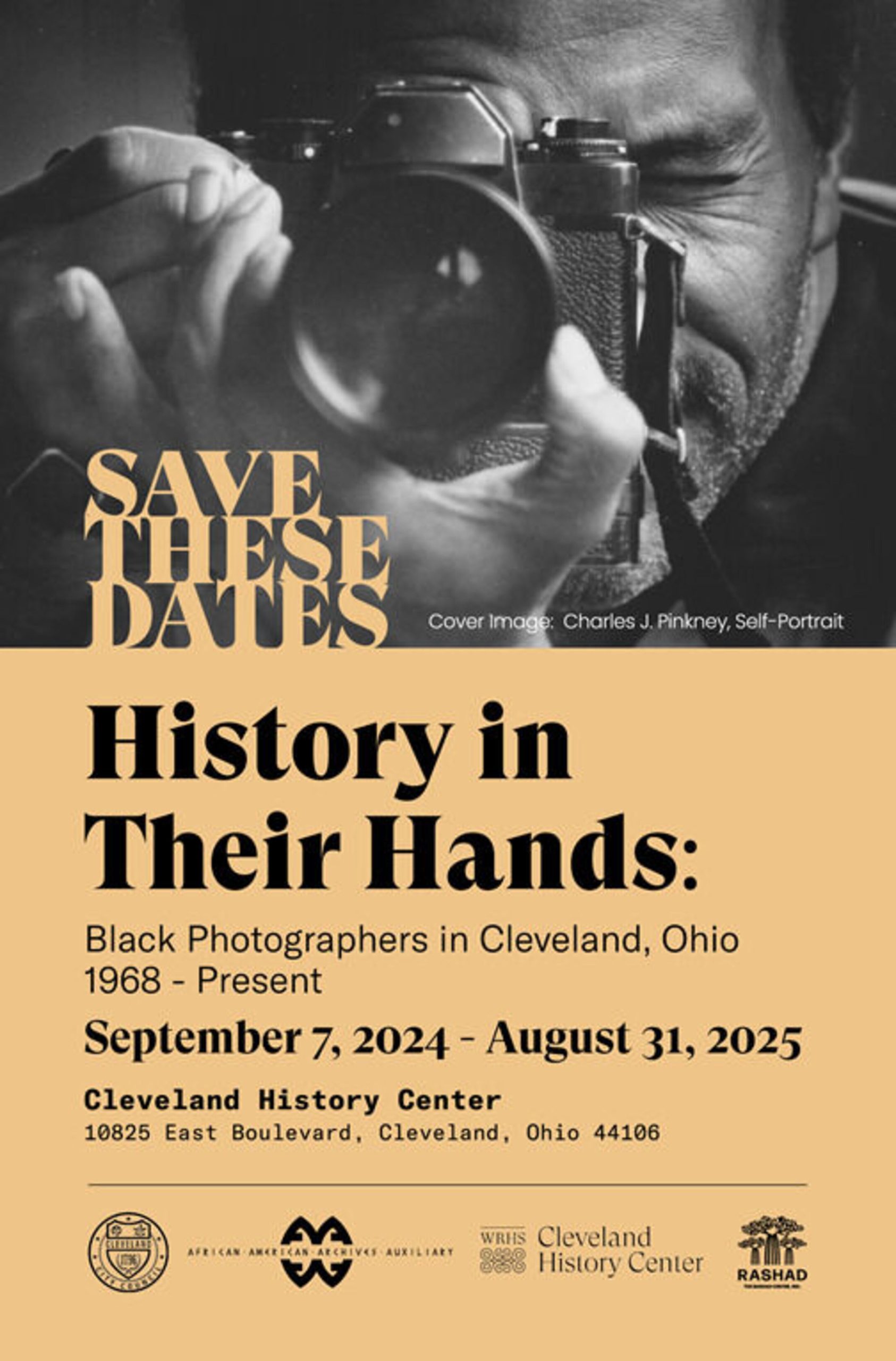
Inside the landmark exhibition celebrating Cleveland’s Black photographic legacy, Dr. Regennia N. Williams and creative collaborator Georgio Sabino III bring generations of visual storytellers into focus.
Arts & Culture – Link to Fox 8 News
There is an old saying that a picture is worth a thousand words. In Cleveland, a remarkable group of Black photographers has spent decades proving that a photograph can be worth considerably more: an entire history, a cultural inheritance, a movement, and sometimes a correction to the history books.
At the Western Reserve Historical Society’s Cleveland History Center, History in Their Hands: Black Photographers in Cleveland, Ohio, 1968–Present is more than a photography exhibition. It is an act of cultural preservation and recognition. It gives overdue institutional attention to the artists who documented Black life, political transformation, entertainment, sports, family, and the everyday moments that collectively define a community.
The exhibition opened in September 2024 as the inaugural presentation in WRHS’s new African American History Gallery. Its development was led by Dr. Regennia N. Williams, Distinguished Scholar of African American History and Culture and curator at the Western Reserve Historical Society, alongside a creative team that included Georgio Sabino III, Assistant Curator and Designer, whose creative direction and visual presentation helped shape the exhibition.
Williams brought the historical scholarship. Sabino brought an artist’s eye for visual storytelling. Together, their work created a presentation in which the photographs are not simply displayed; they are given the space, context, and dignity they deserve.
Six Photographers. Generations of History. One Powerful Exhibition.
The real stars of History in Their Hands are the photographers themselves. Six artists, representing different generations and approaches to the medium, provide an extraordinary visual record of Cleveland and the wider African American experience.
Charles J. Pinkney is a master storyteller whose portraits capture the humanity behind public recognition. His photographs of playwright August Wilson, Judge Stephanie Tubbs Jones, and everyday Cleveland residents demonstrate an enduring commitment to honest representation. Pinkney’s philosophy is direct: he wanted his pictures to be truthful, honest, and fair. His images do something particularly important: they challenge stereotypes by presenting Black people in all their complexity, dignity, and beauty.
Van Dillard, the Cleveland Press’s first Black photographer, occupies an essential place in the city’s journalistic history. His photographs document a changing Cleveland and a changing America. From political figures to major cultural moments, Dillard’s archive represents the importance of having photographers who understand the communities they document. His presence in the exhibition is also a reminder that opening doors in the newsroom was itself a historic achievement.
James “Jimmy” Gayle, the Plain Dealer’s first full-time Black photographer, brought a distinctive personality and eye to photojournalism. Known for his humor and ability to capture the image he envisioned, Gayle helped establish a path for generations of Black journalists and photographers. His legacy is especially meaningful through the continued stewardship of his daughter, photographer Gina Gayle.
Gina Gayle carries that photographic legacy forward while establishing her own artistic identity. A photographer and professor at Boston College, she brings a contemporary perspective to the exhibition. Her participation makes the presentation particularly moving: photography becomes both a personal inheritance and an evolving creative practice.
Mychal Lilly is an accomplished photographer whose lens has traveled through sports, music, entertainment, and public life. His photographs include Tina Turner, Gerald Levert, Coretta Scott King, the Tuskegee Airmen, and former Cleveland Cavalier Larry Nance. Lilly understands the importance of timing, access, and visual instinct. His work captures the energy of public moments while preserving the personalities that make those moments memorable.
Amanda D. King represents another generation of Cleveland’s photographic storytellers. Her inclusion alongside established pioneers demonstrates that the city’s photographic history is not a closed chapter. It is an ongoing conversation, with new artists continuing to shape how Black life is seen, understood, and remembered.
Together, these six photographers create a visual dialogue between generations. The exhibition makes a compelling argument: Cleveland’s Black history cannot be fully understood without recognizing the people who stood behind the camera.
Dr. Regennia N. Williams: Scholarship Meets Cultural Stewardship
The intellectual foundation of this exhibition begins with Dr. Williams. Her work as a historian, scholar, and curator reflects a sustained commitment to documenting African American history and making that history accessible to the public.
The idea developed in part from earlier work surrounding photographer Allen E. Cole. Williams co-authored the 2012 publication Through the Lens of Allen E. Cole with Sam Black, former curator of African American history at WRHS. Cole’s archive reportedly contained more than 50,000 photographs documenting Black life in Cleveland.
A 2022 recognition event honoring nine Black photographers further inspired Williams to envision a permanent space where their contributions could be seen together.
As she explained to The Land, the opportunity to establish a dedicated African American history and culture gallery provided the occasion to make African American photography its inaugural exhibition.
Her curatorial achievement is not simply the recovery of images. It is the restoration of context. Photographs become more powerful when viewers understand who made them, why they were made, and what was happening beyond the frame.
Georgio Sabino III: The Artist Behind the Visual Presentation
For Georgio Sabino III, the exhibition represents a meaningful intersection of his professional lives as an artist, photographer, designer, educator, and cultural storyteller.
His contribution as Assistant Curator and Designer extended beyond arranging photographs on walls. The visual presentation required sensitivity to the historical significance of the images, the personalities of the photographers, and the architecture of the museum itself.
The historic Bingham-Hanna Mansion presented a particular design challenge. Its walls could not simply be repainted to accommodate the exhibition. The solution included carefully designed presentation panels, while the photographers advocated for white frames to allow their images to stand apart.
That detail might sound small, but in exhibition design, small decisions have large consequences. A frame can either compete with a photograph or allow it to speak. Here, the photographs deserved the last word.
Sabino’s wider creative practice includes photography, fine art, fashion, and augmented reality. He has also participated in the Smithsonian-Cleveland Partnership connected to the National Museum of African American History and Culture. His work across these disciplines reflects a larger commitment to preserving cultural narratives while exploring new ways to present them.
When Cleveland’s History Gets Its Close-Up
The exhibition attracted broader attention when FOX 8’s Kenny Crumpton visited the Cleveland History Center for Kickin’ It with Kenny. His segment, “Kenny Explores History Through the Eyes of Cleveland Black Photographers,” introduced television audiences to the photographers and the historical significance of their work.
News 5 Cleveland also featured the exhibition, with reporter Damon Maloney highlighting the perspectives of Pinkney, Lilly, and Dr. Williams. The Land published an in-depth feature by veteran journalist Gregory Burnett, examining the photographers’ careers, the curatorial decisions, and the importance of finally giving these artists their due.
This attention is deserved. For too long, the contributions of Black photographers have been recognized within their communities without receiving equivalent space in major cultural institutions.
History in Their Hands challenges that imbalance.
The exhibition’s greatest achievement may be its insistence that history is not made only by the people standing in front of the camera. It is also made by those who recognize the importance of the moment, lift the camera, and preserve it for everyone who comes afterward.
Cleveland has no shortage of history. It has no shortage of extraordinary artists, either. What it needs are more opportunities to bring those two things together.
Dr. Regennia Williams, Georgio Sabino III, and the six photographers represented here have made a compelling case for doing exactly that.
And if a picture is worth a thousand words, this exhibition offers Cleveland a library.
The photographers held the cameras. The historians preserved the context. The curators gave the images a home. And the public finally gets to see the full picture.
Published coverage and research sources
The following articles and broadcasts provide supporting coverage, historical context, and independent recognition of the exhibition.
Kenny Crumpton (@KickinKenny) on X
1. FOX 8 Cleveland – Kenny Crumpton
Kenny Explores History Through the Eyes of Cleveland Black Photographers
The television feature brings the exhibition and its participating photographers to a broader audience.
Damon Maloney – Journalist Profile – Intelligent Relations
2. News 5 Cleveland – Damon Maloney
Black Photographers Share Poignant Work in New Exhibit Highlighting African American Contributions to History
Interviews with Charles Pinkney, Mychal Lilly, and Dr. Regennia Williams.
news5cleveland.com
3. The Land – Gregory Burnett
Finally Getting Their ‘Due’: Exhibit Honors Cleveland’s Pioneering Black Photographers
Particularly valuable for the history of Dr. Williams’ curatorial vision, the photographers’ backgrounds, and the exhibition’s design.
The Land+1
4. CoolCleveland
Western Reserve Historical Society Opens New African American Gallery
Covers the inaugural exhibition, the gallery opening, and the photographers represented.
5. Cuyahoga County Public Library
Black History and Photographic Memories – Illustrated Lecture-Discussion by Regennia N. Williams, PhD
Demonstrates the educational and historical significance of the exhibition and Williams’ scholarship.
Cuyahoga County Public Library
6. Smithsonian-Cleveland Partnership
Georgio Sabino III’s broader cultural work includes participation in the Smithsonian-Cleveland Partnership alongside Regennia Williams and Charesha Barrett.
Read about the Smithsonian-Cleveland Partnership
Recommended hashtags
ART HISTORY • CURATORSHIP • PHOTOGRAPHY • CULTURAL PRESERVATION
#HistoryInTheirHands #BlackPhotographers #BlackPhotography #AfricanAmericanPhotography #ClevelandPhotographers #ClevelandArt #ClevelandHistory #WRHS #WesternReserveHistoricalSociety #ClevelandHistoryCenter #AfricanAmericanHistory #BlackVisualArtists #BlackArtHistory #BlackPhotojournalism #VisualStorytelling #PhotographyExhibition #ArtCurator #MuseumCurator #RegenniaWilliams #GeorgioSabinoIII #GS3Photography #CulturalPreservation #SmithsonianNMAAHC #SmithsonianClevelandPartnership #BlackArchives #BlackExcellence #ArtInAmerica #ArtBasel #NYCArtScene #ParisArtScene