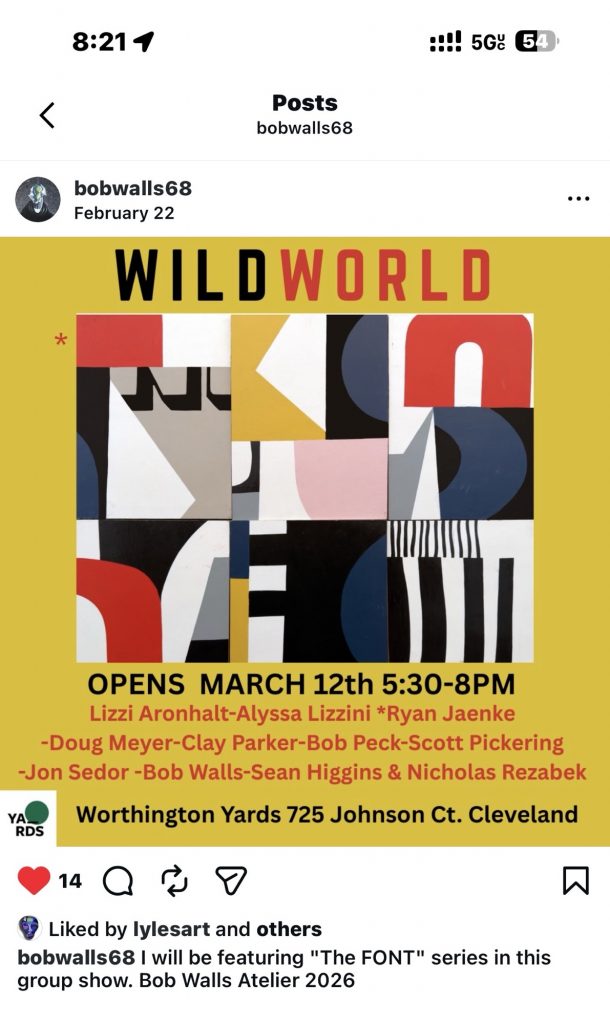
In the evolving landscape of contemporary American art, certain artists emerge not through institutional pipelines but through persistence, imagination, and a deeply personal visual language forged over decades. One such artist is Cleveland-based painter Bob Walls, whose work fuses inner-city narrative, surrealist symbolism, and musical improvisation into a striking visual vocabulary that feels both deeply personal and culturally expansive.
Walls’ artistic journey began not in galleries but in the fertile imagination of adolescence.
“I feel like I’ve been an artist my whole life,” he reflects. “But I really began concentrating on art when I was about twelve or thirteen. At first, I wanted to be a comic book artist.”
That early fascination with illustrated worlds—dynamic characters, stylized movement, exaggerated imagination—never truly disappeared. Instead, it evolved. Over time, the comic book sensibility matured into something more atmospheric and painterly. What began as ink and fantasy transformed into oil and acrylic, dreamscape and symbolism.
“If someone told me thirty years ago I’d become a contemporary artist,” Walls says with a laugh, “I wouldn’t have believed them. But art evolves in strange ways.”
Indeed, evolution is the defining principle of Walls’ practice. His paintings operate like visual compositions—structured yet improvisational—where color, language, and symbolism riff off one another like musicians in a jazz ensemble.
Music as Visual Language

Walls describes his work as a translation of sound into imagery.
The rhythm and orchestral elegance of Duke Ellington, the psychedelic funk mythology of George Clinton and Parliament-Funkadelic, and the visionary imagination of Stevie Wonder all pulse through his canvases.
But Walls does not simply illustrate music; he internalizes its structure. Jazz improvisation becomes composition. Funk rhythm becomes color. Melody becomes narrative flow.
The result is a kind of visual jazz—paintings that swing between structure and improvisation.
His influences extend beyond music into the canon of surrealism. One senses echoes of the dreamlike distortions of Salvador Dalí and the philosophical visual puzzles of René Magritte. Yet Walls’ work diverges from European surrealism through a distinctly Black cultural perspective shaped by life in Cleveland’s inner city.
Here, imagination becomes both escape and analysis.
“Part of my work is personal, part of it is imaginative,” Walls explains. “But it all comes from the same place—life, music, and the world I grew up in.”
The Architecture of Words
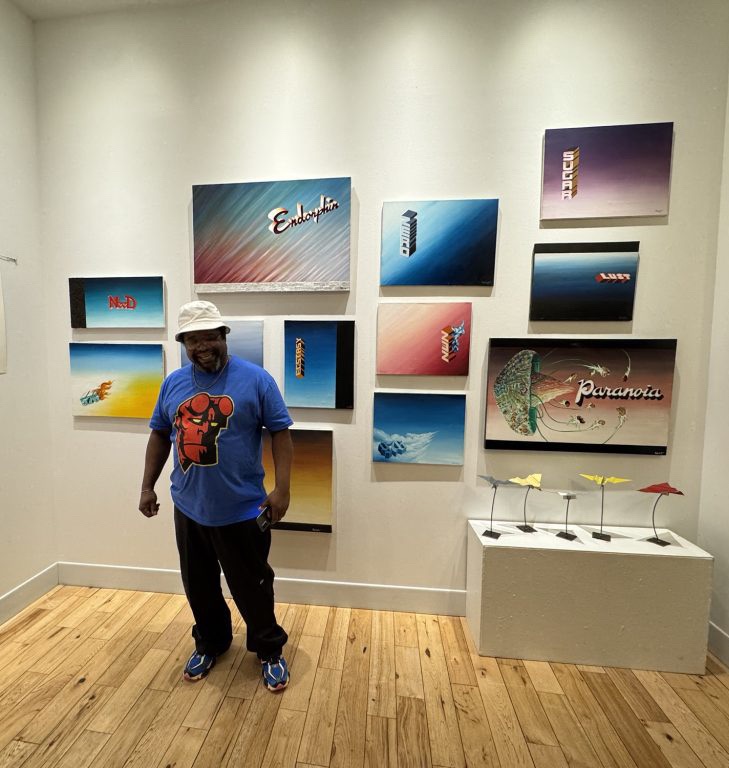
Currently featured in an exhibition at the YARDS Project, curated by Cleveland arts leader Liz Maugans, Walls’ newest body of work explores a sophisticated relationship between language, symbolism, and psychological space.
Working primarily in acrylic on panel and oil on canvas, Walls merges painterly gesture with graphic design instincts. Words become structural elements rather than captions. Typography bends, curls, and dissolves into the atmosphere of the painting.
In his series The Font, ordinary words—Dream, Watch, Paranoia—transform into sculptural forms embedded within surreal landscapes.
Letters twist into architectural frameworks.
Language becomes object.
Meaning becomes environment.
Typography, in Walls’ universe, is not static—it is alive.
A single word might hover like a monument, dissolve like fog, or fracture into visual fragments that populate the surrounding imagery. Figures, animal forms, and electrical lines weave through these textual architectures, suggesting subconscious networks between thought, fear, aspiration, and memory Maugans said.

The paintings oscillate between clarity and ambiguity. The word anchors the viewer, but everything around it resists easy interpretation.
This tension is deliberate.
Walls invites the viewer to confront language not just as communication, but as psychological trigger and cultural symbol.
A Cleveland Surrealist
Though his influences span continents and genres—from pop surrealism to conceptual text-based art—Walls remains rooted in the geography that shaped him.
Cleveland has long produced artists who operate outside traditional art market narratives, developing distinctive visual dialects shaped by industrial landscapes, working-class histories, and layered cultural identities shared Liz Maugans.
Walls’ exhibitions across Pennsylvania and throughout Northeast Ohio have steadily built a reputation for work that feels both graphic and philosophical—part painting, part visual poetry.
And while his journey has been gradual, he views the current exhibition not as a culmination but as a threshold.
“The sky is the limit,” he says. “This is one of the stepping stones. As time goes on, I see more and more of the future in the work I’m doing today.”
Painting the Dream
Standing before a Bob Walls canvas is a bit like hearing a new genre of music for the first time. The rhythm feels familiar, yet the structure is unexpected.
Words become landscapes.
Symbols become characters.
Color becomes sound.
In a cultural moment where visual language often moves faster than meaning, Walls slows the viewer down—inviting them to wander through the architecture of thought itself.
Like the great bandleaders he admires, Bob Walls conducts a complex orchestra of ideas. The instruments are color, typography, and memory. The stage is the canvas.
And the performance, still unfolding, is the dream he began sketching decades ago.