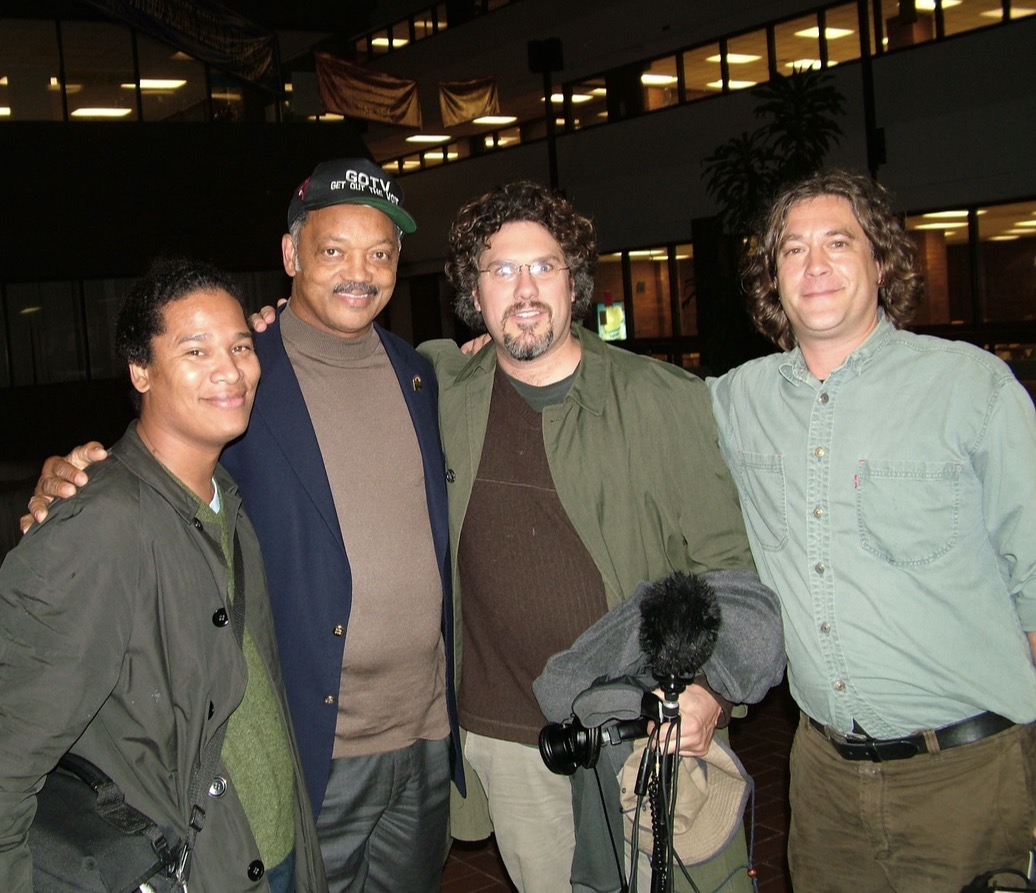
I still carry vivid memories of the moments I encountered Reverend Jesse Jackson, a man whose presence felt larger than the rooms he entered. The first time I met him was in Cleveland, not long after the debate between Senator Barack Obama and Hillary Clinton. I was there working as a photographer, navigating the charged atmosphere where politics, media, and history converged. Beside me stood my niece, Paige Smith — then a young journalist — filming with a steady focus that belied her age. Backstage, amid the swirl of campaign staff and whispered strategy, I had the distinct honor of introducing my nephew, Aaron Sabino, to Reverend Jesse Jackson, a true civil rights superhero whose legacy continues to inspire generations and the power networking conference by Dr. George Fraser. Jesse Jackson carried an unmistakable gravity. When we met, it was brief, but it was enough. It felt like standing near a current of history still in motion.
Seeing him again on the campaign trail reinforced something deeper for me. Jackson was not only a civil rights activist; he became, in my own journey, another reason to believe activism was a calling rather than an abstract ideal. He was an icon who demonstrated that moral conviction could be public, disciplined, and courageous. Years later, I would meet him again at the Congressional Black Caucus gathering in Washington, D.C., where I attended with Silver B. Richards, a local legend from Cleveland. In those spaces, Jackson’s legacy was palpable — his voice echoing through decades of struggle, coalition-building, and relentless advocacy. His leadership symbolized a bridge linking the unfinished work of the Civil Rights Movement with contemporary battles for equity and dignity.

Jackson’s associations underscored his place within a lineage of transformative figures. He stood alongside giants like Dr. Martin Luther King Jr., shared platforms with Al Sharpton, and worked closely with Ambassador Andrew Young. He invoked the global moral arc embodied by Nelson Mandela, reminding us that civil rights was never solely an American story, but a human one. Jackson walked — literally and symbolically — in the footsteps of those (MLK) who crossed the Edmund Pettus Bridge, where courage met brutality and where democracy itself was tested. For many, he was a leader. For me, he was a brick — another brick in the foundation shaping my understanding of ancestry, responsibility, and the African-American experience.
In 1988, I was 18 years old, witnessing history unfold as Jackson ran for president, expanding what felt politically imaginable. His campaigns were not merely electoral exercises; they were declarations of belonging. Figures like Bernie Sanders, who served as a delegate during Jackson’s presidential run, reflected the breadth of the coalition he sought to build. Jackson called it a Rainbow Coalition — a vision insisting that justice must be inclusive, that equality and equity were inseparable from progress. His words still resonate: “Keep hope alive.” And equally enduring: “You are qualified. You are able.” These were not slogans; they were affirmations aimed at those long told to doubt their worth.
It is bittersweet to reflect on his legacy in our present moment. Civil rights, which exist to protect all people — Black, white, Asian, East Asian, Latino, Indigenous — sometimes feel fragile under shifting political winds. Yet Jackson’s example reminds us that rights are never self-sustaining; they endure through vigilance, participation, and courage. I remember the emotion on his face when Barack Obama rose to the presidency — tears that captured not only personal pride, but the weight of generations who struggled to make that moment possible.
I share my photographs now in honor of Jesse Jackson during Black History Month — images not just of a man, but of a movement, a voice, a conviction. I pray for our country, and I pray that we each look inward. Jackson’s life asks something of us: to resist cynicism, to reject division, and to remember that justice must mean justice for all. The introspective, righteous voice within each of us might dare to say: I am Jesse Jackson — at my best. And at our best, perhaps we too can keep hope alive.